Assistive Device Workers Comp Reimbursement: What Crutches, Braces, Walkers & Wheelchairs Are Covered?
Learn how assistive device workers comp reimbursement works, when crutches, braces, walkers, wheelchairs and mileage are covered, what documentation insurers need, and how to speed durable medical equipment approval WC. Get practical steps to file claims, avoid denials, appeal decisions, and examples like crutches compensation workers comp and medical brace work injury claim approvals now.
Estimated reading time: 18 minutes
Key Takeaways
Crutches, braces, walkers, and wheelchairs are commonly covered when the treating doctor documents medical necessity and the insurer approves the request, subject to state rules and carrier policies.
Most payers require durable medical equipment approval WC through prior authorization or review; accurate paperwork, HCPCS/CPT coding, and accredited suppliers reduce delays.
Mileage to authorized medical visits and DME fittings is often reimbursable, but rates and rules vary by state and insurer.
Assistive device workers comp reimbursement may be handled by direct supplier billing; if the worker pays out-of-pocket, keep receipts and submit promptly with the claim number and approval records.
Common denials stem from missing documentation, coding errors, or non-network suppliers; timely appeals with stronger clinical evidence can reverse many decisions.
Table of Contents
Introduction
Short Primer: How Workers’ Comp Handles Medical Items
Durable Medical Equipment Approval WC: How Approval Works
— Approval Pathways
— Common Documentation Required
— Billing & Coding Basics
— Vendor Accreditation & Approved Supplier Lists
Assistive Device Workers Comp Reimbursement: General Rules and Timing
— Purchase vs Rental and Payment Flows
— Timing Expectations
Device-Specific Coverage & Guidelines
— Crutches — crutches compensation workers comp
— Braces — medical brace work injury claim
— Walkers & Wheelchairs — workers comp pay for walker or wheelchair
— Durable Medical Equipment Approval WC — Practical checklist for crutches, braces, walkers & wheelchairs
Mileage, Transportation & Related Reimbursements
Practical How-To: Steps for Injured Workers, Treating Clinicians & Adjusters
— For Injured Workers
— For Treating Clinicians
— For Employers and Adjusters
Common Denials and Appeals
Cost Expectations and Examples
Disclaimer
Conclusion
FAQ
Introduction
Assistive device workers comp reimbursement is a common question after a work injury — this guide explains when crutches, braces, walkers, wheelchairs and related mileage are reimbursable and exactly how durable medical equipment approval works.
This article answers whether mileage, crutches, wheelchairs, or braces are reimbursable under workers’ comp, what documentation payers typically require, and practical steps injured workers, clinicians, and adjusters should follow.
Featured answer: Yes — crutches, braces, walkers and wheelchairs are typically reimbursable under workers' comp if medically necessary and approved; mileage for travel to authorized treatment is often reimbursed — requirements vary by state and insurer.
Yes — crutches, braces, walkers and wheelchairs are often covered when medically necessary and approved (sources below). See practical overviews of coverage and DME in workers’ comp from EMD Law, a focused explainer on DME in comp from WorkInjuryHelp, and additional DME basics from ProficientRx.
Mileage for travel to authorized medical treatment is commonly reimbursable; details depend on state/carrier, as noted in this California medical expenses overview.
Approval depends on medical necessity, prescribing clinician documentation, correct coding and often prior authorization.
Citations: EMD Law | WorkInjuryHelp | ProficientRx | Cramer & Martinez
For background on covered benefits and filing steps, you can also review our guides to what benefits workers’ comp covers and how to file a workers’ comp claim.
Short Primer: How Workers’ Comp Handles Medical Items
Durable Medical Equipment (DME) refers to reusable medical devices required for treatment or mobility, including crutches, canes, walkers, wheelchairs, braces, hospital beds and commodes. In the workers’ compensation setting, DME is used to cure or relieve the effects of a job-related injury and support safe recovery. Overviews of DME categories and how comp carriers evaluate them are available from WorkInjuryHelp and ProficientRx.
Assistive devices are a subset of DME designed to improve mobility or activities of daily living. Common examples include crutches for a tibial fracture or a hinged knee brace for a ligament sprain. If a cane is insufficient because of poor balance, a walker may be prescribed for safety.
Most payers apply a medical necessity standard. Medical necessity means the treating physician documents that the device is required to cure or relieve the effects of a work-related injury or to aid recovery; this must be supported by clinical notes and objective findings. See discussions of necessity and documentation in WorkInjuryHelp’s DME guide and this overview of assistive devices in comp from PI Law.
Prior authorization and payer review are common. Many carriers require prior authorization or a formal utilization review before payment—either via a clinician-submitted form or through a vendor request pathway. This is described in both the WorkInjuryHelp DME article and the Cramer & Martinez California coverage overview.
Rules vary by state and insurer. State statutes, utilization review frameworks, and individual carrier policies can differ significantly, so always cross-check state workers’ compensation commission resources and the carrier’s DME policy. Helpful starting points include PI Law’s assistive devices overview and the Pride Mobility funding page for workers’ comp considerations. If you’re unsure how to document medical necessity for DME, see our guide to documenting a work injury.
Durable Medical Equipment Approval WC: How Approval Works
Durable medical equipment approval WC hinges on clinician orders, supporting clinical documentation, correct coding, and vendor eligibility.
Approval Pathways
Physician order & clinical notes. Include date, diagnosis with ICD-10, functional limitations, the specific device ordered (make/model if applicable), expected duration of need, and objective findings (gait, range of motion, neurovascular status). A clear narrative reduces denials. Sample phrase: “Patient requires [device] for safe ambulation due to [diagnosis]; without device patient is at increased fall risk and cannot perform work duties.” See DME documentation guidance from WorkInjuryHelp and assistive device criteria discussed at PI Law.
Prior authorization/form submission. Typical forms collect patient demographics, claimant ID/claim number, device HCPCS/CPT codes, estimated cost, and a medical necessity justification with attachments. Review times vary—crutches may be same-day while complex DME can take 1–3 weeks. See prior-review expectations in Cramer & Martinez.
Vendor-supplied paperwork. Suppliers often add an estimate/quote, proof of accreditation, fitting notes, and trial documentation. Many payers have preferred suppliers or network rules that must be followed, discussed in ProficientRx and the Pride Mobility funding page.
Common Documentation Required
Diagnosis and ICD-10 code(s)
Physician narrative of medical necessity and expected duration
Imaging or diagnostic results where relevant (X-ray, MRI)
Mobility/functional assessments (e.g., timed up-and-go, gait assessment)
Trial or loaner notes (if device was trialed)
Supplier estimate with HCPCS/CPT codes
Proof supplier is accredited or on payer’s approved list
For more on what to include and why, see WorkInjuryHelp’s DME article and ProficientRx’s DME overview. To keep your file complete, consider the recordkeeping tips in our documentation guide.
Billing & Coding Basics
HCPCS and CPT codes identify the exact device or service. Correct codes reduce technical denials and speed review. Include units, applicable modifiers, and whether the item is a purchase or rental.
Examples of commonly used HCPCS codes (verify current coding with CMS/insurer):
Device | Example HCPCS Codes | Notes |
|---|---|---|
Crutches | E0110, E0111, E0112, E0113, E0114 | Underarm/forearm, adjustable vs. fixed; list type in order |
Walker | E0140–E0149 | Standard vs. wheeled; check vendor variations |
Manual wheelchair | E1161; E1220–E1231 | Ranges vary by configuration and seating |
Power wheelchair | K0840–K0899 | Insurer-specific criteria often apply |
Lower-extremity braces | L-codes (orthotics), selected E-series items | Confirm L-codes with orthotist and payer |
For official coding references, use the CMS HCPCS code sets or your insurer’s DME coding resources.
Vendor Accreditation & Approved Supplier Lists
Many payers require accredited suppliers to prevent fraud and ensure quality. Ask the claims adjuster for the current approved supplier list and confirm the supplier’s NPI and state DME license before ordering. These network and accreditation expectations are discussed in ProficientRx’s DME guide and the Pride Mobility workers’ comp funding page. If you need help navigating networks, see our guidance on choosing medical providers in workers’ comp.
Assistive Device Workers Comp Reimbursement: General Rules and Timing
Assistive device workers comp reimbursement depends on whether the device is purchased or rented, whether it's temporary or long-term, and the insurer’s policy on replacement and repairs.
Purchase vs Rental and Payment Flows
For short-term needs—like the cast period after a fracture or a reversible injury—rental is common, sometimes with rental-to-purchase conversion if cumulative payments reach a threshold. For long-term or permanent limitations, purchase is more likely, often supported by durability testing and a stronger necessity narrative. These patterns are noted in WorkInjuryHelp’s DME explainer and ProficientRx.
Insurers may cap replacement intervals and amounts. For instance, a wheelchair might be replaced every 3–5 years unless a change in condition or device failure justifies earlier replacement. Repairs and replacement parts are often covered when due to normal wear or accidental damage, supported by a repair estimate and photos.
Payment typically flows via direct billing from the supplier to the insurer, avoiding upfront costs for the worker. If the worker pays out-of-pocket, submit the itemized invoice, receipts, claim number, and prior authorization to request reimbursement. Federal claimants can use the Department of Labor’s OWCP-915 medical expense reimbursement form to request repayment for approved medical items and travel.
Timing Expectations
Expect faster approvals for simple, low-cost items and longer timelines for custom or powered devices. These ranges align with common payer review practices described by WorkInjuryHelp and ProficientRx.
What to expect | Typical timeline |
|---|---|
Simple DME (e.g., crutches, standard walker) | 0–3 days |
Standard DME (e.g., off-the-shelf brace, manual wheelchair) | 3–14 days |
Complex/custom DME (e.g., custom brace, power wheelchair) | 2–6+ weeks |
If reimbursement is delayed, check our step-by-step guide on unpaid workers’ comp medical bills and consider the tips in our article on when a workers’ comp adjuster is not responding.
Device-Specific Coverage & Guidelines
Crutches — crutches compensation workers comp
Crutches are among the most commonly approved assistive devices in workers’ comp claims when prescribed for ambulation limitations after a work injury. Typical qualifying conditions include ankle or tibial fractures, severe sprains, and post-operative non-weight-bearing orders.
Crutches compensation workers comp requests should include a physician prescription with ICD-10 diagnosis, explicit weight-bearing restrictions (for example, “non-weight-bearing on right lower extremity until [date]”), and objective mobility findings. If requesting replacement due to breakage, attach progress notes and, if available, photos of damage.
HCPCS coding supports fast approval. Common HCPCS examples include E0110–E0114. For instance, E0114 often describes underarm crutches, adjustable. Accurate code selection and item description reduce technical denials and help suppliers bill correctly.
Replacement frequency is typically flexible given low cost. Many carriers authorize replacement if crutches are broken or lost and still medically necessary. Suppliers often bill insurers directly. If you pay out-of-pocket, save receipts, note your claim number, and submit promptly for assistive device workers comp reimbursement. For general coverage context, see summaries from EMD Law, WorkInjuryHelp, and ProficientRx.
Scenarios to anticipate:
Simple non-weight-bearing order after surgery: crutches compensation workers comp approval commonly within 24–72 hours.
Crutches damaged at home while still on restrictions: swift replacement with brief note documenting ongoing medical need.
Braces — medical brace work injury claim
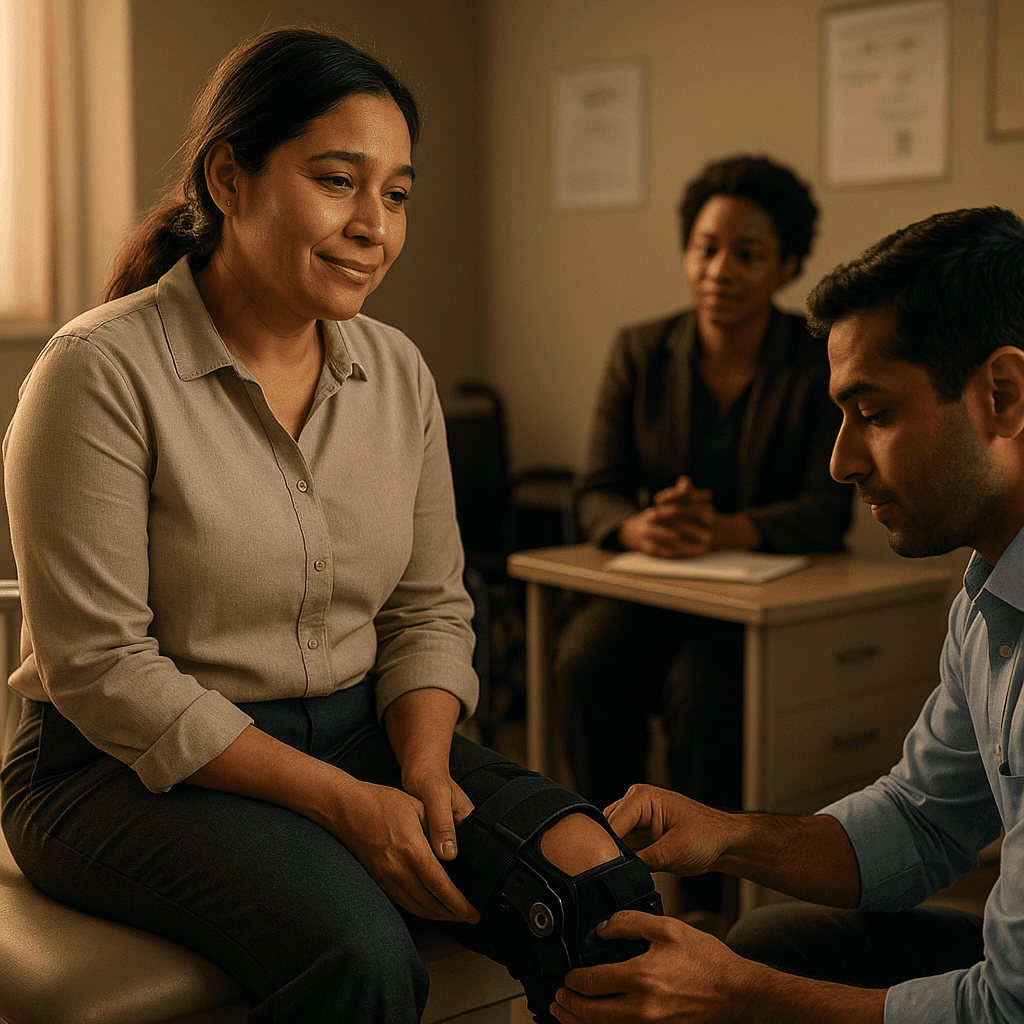
Braces are covered when medically necessary to stabilize, protect or immobilize injured joints or the spine; coverage differs for off-the-shelf versus custom orthoses. Off-the-shelf (OTC) items—like knee sleeves, wrist splints, and certain back supports—usually require a physician note and diagnosis, while custom/fabricated braces often require an orthotist assessment, measurements, fitting notes, and stronger justification showing failed conservative care. See DME process notes in ProficientRx and WorkInjuryHelp.
Documentation should include fitting notes (orthotist/therapist/clinician), confirmation that the device improves stability or reduces pain, and photos if requested. Example clinician narrative for a medical brace work injury claim: “Off-the-shelf knee brace recommended to stabilize Grade II MCL tear to allow limited weight-bearing and prevent valgus collapse during ambulation.”
Braces often support safer, faster return-to-work on modified duty. Clinicians can tie restrictions to the brace: “May return to light duty while wearing wrist splint; no lifting >10 lbs; no repetitive grip more than 10 minutes/hour.” Clear restrictions help employers accommodate safely.
For coding, use orthotic L-codes or insurer-specific HCPCS as appropriate. Confirm codes with the supplier and payer, and consider preauthorization when the brace is custom or higher cost. Keep the medical brace work injury claim record organized with clear necessity statements, objective tests, and prior conservative care notes.
Walkers & Wheelchairs — workers comp pay for walker or wheelchair
Walkers and wheelchairs are reimbursable when ordered for medically necessary mobility limitations; payers distinguish simple walkers from manual and powered wheelchairs based on documentation and functional need.
Walkers. Indications include balance problems, restricted weight-bearing, and post-op stability needs. Documentation should justify a walker over a cane or crutches, include weight-bearing instructions, and—if possible—trial notes. Typical costs range from approximately $100–$300, with HCPCS E0140–E0149 commonly used (verify exact codes with supplier/insurer). See general DME guidance at WorkInjuryHelp and ProficientRx.
Wheelchairs. Functional thresholds drive approval. A manual wheelchair may be justified when the claimant cannot safely ambulate long distances despite using a walker or crutches. A power wheelchair may be warranted when severe proximal weakness, cardiopulmonary limitations, or upper-extremity deficits prevent safe self-propulsion of a manual chair. Include a mobility assessment, failed trials of simpler devices, ADL/work limitations, home/work accessibility considerations, and a detailed supplier evaluation. Rentals are common for acute needs; purchases are more likely for long-term disabilities. Insurers often authorize batteries, replacement parts, and repairs with a supplier estimate. For payer expectations and supplier issues, see ProficientRx, WorkInjuryHelp, and Pride Mobility’s workers’ comp funding page.
Practical examples tied to workers comp pay for walker or wheelchair:
If a claimant can stand but cannot walk >50 feet, a manual wheelchair may be approved when a mobility assessment supports the limitation.
If a claimant cannot use hands effectively to propel a manual chair, documentation of upper-extremity deficits and ADL impact can justify a power wheelchair.
Durable Medical Equipment Approval WC — Practical checklist for crutches, braces, walkers & wheelchairs
Crutches: Prescription with weight-bearing status; ICD-10; HCPCS (E0110–E0114); supplier estimate if required.
Braces: Physician narrative of necessity; conservative care/therapy notes; orthotist fitting notes for custom devices; correct L-codes or HCPCS.
Walkers: Prescription citing specific mobility limitation; functional assessment; HCPCS (E0140–E0149); supplier quote and network status.
Manual wheelchairs: Mobility assessment; documentation of failed simpler devices; home environment/access notes; HCPCS codes; supplier accreditation proof.
Power wheelchairs: Detailed functional assessment; inability to safely use manual chair; battery/replacement needs; trial/loaner notes; prior authorization form with attachments.
Attach relevant imaging, pre/post-op notes, and photos from fittings or trials. These documentation practices align with DME guidance from WorkInjuryHelp, ProficientRx, and Pride Mobility’s funding page. If the claim is contested, see our guide to appealing a workers’ comp denial.
Mileage, Transportation & Related Reimbursements
Mileage and transportation costs to authorized medical treatment (including DME fittings/training) are commonly reimbursable under workers’ comp, though rules and rates vary by state and insurer. California-specific mileage guidance illustrates these principles in Cramer & Martinez’s overview.
Travel to/from authorized appointments: Commonly reimbursed when medically necessary and related to the claim.
Travel to pick up equipment: May be reimbursed if delivery is not available or clinically inappropriate, and the trip is tied to authorized care.
Non-authorized travel: Typically not reimbursed.
To claim mileage, keep a log with date, origin/destination, purpose, miles driven, appointment confirmations, and the claim number. Because rates vary by state and do not always match IRS rates, check your insurer’s guidance or your state’s workers’ compensation page. For a deeper walk-through, see our California mileage reimbursement guide. If a mileage claim is denied, review how to dispute denied mileage reimbursements.
Practical How-To: Steps for Injured Workers, Treating Clinicians & Adjusters
For Injured Workers
Notify your employer/claims adjuster promptly and ask about durable medical equipment approval WC preauthorization and approved suppliers.
Obtain a written prescription that specifies the device, ICD-10 diagnosis, and anticipated duration of need.
Ask your clinician to include objective findings and functional limits in notes (e.g., unable to ambulate >50 feet; non-weight-bearing on RLE).
Track all travel in a mileage log (dates, addresses, purpose, miles) and include appointment confirmations.
Request the supplier to bill the insurer directly; if you pay out-of-pocket, save itemized receipts and note the claim number for prompt assistive device workers comp reimbursement.
Save approvals/denials and correspondence in a single file to streamline appeals if needed.
If your employer resists or delays filing, follow the steps in what to do when an employer refuses to file a claim.
For Treating Clinicians
Write concise, specific medical necessity statements: diagnosis with ICD-10; how the device addresses the limitation; objective measures (e.g., failed timed up-and-go, positive instability tests).
Include recommended HCPCS/CPT codes when known; if unsure, describe the device precisely and note that the supplier will confirm codes.
Attach trial notes and conservative care history (e.g., PT progress, medication response) to support durable medical equipment approval WC.
Add imaging and specialist consults when relevant, and document expected duration and replacement/repair needs.
For more on organizing the file and medical evidence, see our guide to documenting a work injury.
For Employers and Adjusters
Verify supplier accreditation and network participation before authorization; maintain a current approved supplier list.
Consider rental for short-term device needs and compare rental-to-purchase conversion thresholds for cost-effective outcomes.
Track replacement cycles and repair authorization processes to control costs without compromising medical necessity.
Use a durable medical equipment approval WC checklist to prevent technical denials (codes, clinical notes, supplier credentials, and clear justification).
To understand broader benefits and how approvals fit into the claim lifecycle, review what benefits workers’ comp covers.
Common Denials and Appeals
Understanding common denial reasons helps you prevent and successfully appeal refusals for DME and mileage reimbursement.
Lack of sufficient clinical documentation or missing ICD-10 code
Device deemed not medically necessary or not supported by objective findings
Supplier not in-network or not accredited
Incorrect HCPCS/CPT coding or billing errors
Exceeded replacement interval or capped allowance
How to contest denials:
Review the denial letter for the exact reason and deadline to appeal.
Gather supplemental evidence: updated clinician narrative, functional assessments, imaging, supplier quotes, photos, and trial notes.
Draft an appeal including claimant info, claim number, date of original request, what was requested and why, a list of attachments, and a clear request for reversal.
Request independent medical review or use your state-level appeal options where available; state commission pages often outline procedures.
Consider counsel if the appeal is denied and the DME is crucial for daily function or a safe return-to-work. For a full process overview, see our guide to appealing a workers’ comp denial.
Appeals letter essentials you can copy into a formal letter:
Claimant name, claim number, date of request and denial
Specific device/service requested with HCPCS/CPT code and cost estimate
Clear medical necessity statement with objective support
List of attachments (clinical notes, imaging, supplier quote, trial notes)
Request for reversal and expedited processing if function/safety at risk
If you paid for the device or travel and need reimbursement on a federal claim, submit the OWCP-915 reimbursement form. For diagnostic disputes that slow DME approval, see our guide on appealing denied imaging.
Cost Expectations and Examples
Provide realistic cost ranges so readers can anticipate insurer responses and understand the financial stakes for rentals vs purchases. While costs vary by supplier, state, and product level, the ranges below reflect common market observations for approval planning. See DME cost context in ProficientRx and coverage patterns in WorkInjuryHelp.
Device | Approximate range | Notes |
|---|---|---|
Crutches | $30–$100 | Low-cost; typically fast approval with prescription (source) |
Off-the-shelf brace | $75–$300 | Prescription and brief necessity note |
Custom brace | $500–$1,500+ | Often requires orthotist evaluation and prior auth |
Walker | $100–$300 | Usually quick approval with mobility documentation |
Manual wheelchair | $500–$2,500 | Rental vs purchase varies by expected duration |
Power wheelchair | $2,500–$10,000+ | Extensive documentation; may include trial/UR review |
Sample scenarios:
Simple crutches: Doctor orders; supplier bills insurer; approval within days.
Custom lumbar brace: Orthotist evaluation and prior authorization; 1–2 weeks typical.
Power wheelchair: Mobility assessment, failed trial of simpler devices, supplier report; utilization review may extend timelines to several weeks.
Disclaimer
This article is informational only and not legal advice. Workers’ compensation laws and coverage criteria vary by state and insurer. Consult your claims adjuster, state workers’ compensation commission, or an attorney for guidance on your situation.
As an example of official resources, see California’s Department of Workers’ Compensation for rules and forms on its state commission website.
Conclusion
With the right prescription, clear medical necessity, correct HCPCS coding, and an accredited supplier, most crutches, braces, walkers, and wheelchairs are reimbursable under workers’ comp—and mileage to authorized appointments is often covered, too. If a request is denied, strengthen documentation, check network and code issues, and appeal within the stated deadline.
Need help now? Get a free and instant case evaluation by US Work Accident Lawyers. See if your case qualifies within 30-seconds at https://usworkaccidentlawyer.com.
FAQ
Is my wheelchair covered if I can still walk short distances?
Possibly. If your clinician documents that a wheelchair is necessary for safety or to perform daily activities or work, workers comp pay for walker or wheelchair can be approved even with limited walking tolerance. See medical necessity discussions in WorkInjuryHelp.
Will workers’ comp reimburse taxi/Uber to appointments?
Often yes for medically necessary transportation to authorized treatment, depending on your state and insurer. Check carrier policies and state rules such as those illustrated in this California medical expenses overview.
Can I choose my supplier?
Sometimes. Insurers frequently require approved or accredited DME suppliers; confirm network rules with your adjuster. For supplier and funding considerations, see ProficientRx and Pride Mobility’s workers’ comp funding page.
How long does approval take?
Simple items like crutches or basic walkers may be approved in days; custom braces and power wheelchairs typically take 1–6+ weeks due to review steps. For process context, see WorkInjuryHelp.
Where do I find durable medical equipment approval WC forms?
Check your state workers’ compensation commission or your insurer’s DME resource page. Federal claimants can use the Department of Labor’s OWCP-915 reimbursement form for approved medical expenses and travel.
Estimated reading time: 18 minutes
Key Takeaways
Crutches, braces, walkers, and wheelchairs are commonly covered when the treating doctor documents medical necessity and the insurer approves the request, subject to state rules and carrier policies.
Most payers require durable medical equipment approval WC through prior authorization or review; accurate paperwork, HCPCS/CPT coding, and accredited suppliers reduce delays.
Mileage to authorized medical visits and DME fittings is often reimbursable, but rates and rules vary by state and insurer.
Assistive device workers comp reimbursement may be handled by direct supplier billing; if the worker pays out-of-pocket, keep receipts and submit promptly with the claim number and approval records.
Common denials stem from missing documentation, coding errors, or non-network suppliers; timely appeals with stronger clinical evidence can reverse many decisions.
Table of Contents
Introduction
Short Primer: How Workers’ Comp Handles Medical Items
Durable Medical Equipment Approval WC: How Approval Works
— Approval Pathways
— Common Documentation Required
— Billing & Coding Basics
— Vendor Accreditation & Approved Supplier Lists
Assistive Device Workers Comp Reimbursement: General Rules and Timing
— Purchase vs Rental and Payment Flows
— Timing Expectations
Device-Specific Coverage & Guidelines
— Crutches — crutches compensation workers comp
— Braces — medical brace work injury claim
— Walkers & Wheelchairs — workers comp pay for walker or wheelchair
— Durable Medical Equipment Approval WC — Practical checklist for crutches, braces, walkers & wheelchairs
Mileage, Transportation & Related Reimbursements
Practical How-To: Steps for Injured Workers, Treating Clinicians & Adjusters
— For Injured Workers
— For Treating Clinicians
— For Employers and Adjusters
Common Denials and Appeals
Cost Expectations and Examples
Disclaimer
Conclusion
FAQ
Introduction
Assistive device workers comp reimbursement is a common question after a work injury — this guide explains when crutches, braces, walkers, wheelchairs and related mileage are reimbursable and exactly how durable medical equipment approval works.
This article answers whether mileage, crutches, wheelchairs, or braces are reimbursable under workers’ comp, what documentation payers typically require, and practical steps injured workers, clinicians, and adjusters should follow.
Featured answer: Yes — crutches, braces, walkers and wheelchairs are typically reimbursable under workers' comp if medically necessary and approved; mileage for travel to authorized treatment is often reimbursed — requirements vary by state and insurer.
Yes — crutches, braces, walkers and wheelchairs are often covered when medically necessary and approved (sources below). See practical overviews of coverage and DME in workers’ comp from EMD Law, a focused explainer on DME in comp from WorkInjuryHelp, and additional DME basics from ProficientRx.
Mileage for travel to authorized medical treatment is commonly reimbursable; details depend on state/carrier, as noted in this California medical expenses overview.
Approval depends on medical necessity, prescribing clinician documentation, correct coding and often prior authorization.
Citations: EMD Law | WorkInjuryHelp | ProficientRx | Cramer & Martinez
For background on covered benefits and filing steps, you can also review our guides to what benefits workers’ comp covers and how to file a workers’ comp claim.
Short Primer: How Workers’ Comp Handles Medical Items
Durable Medical Equipment (DME) refers to reusable medical devices required for treatment or mobility, including crutches, canes, walkers, wheelchairs, braces, hospital beds and commodes. In the workers’ compensation setting, DME is used to cure or relieve the effects of a job-related injury and support safe recovery. Overviews of DME categories and how comp carriers evaluate them are available from WorkInjuryHelp and ProficientRx.
Assistive devices are a subset of DME designed to improve mobility or activities of daily living. Common examples include crutches for a tibial fracture or a hinged knee brace for a ligament sprain. If a cane is insufficient because of poor balance, a walker may be prescribed for safety.
Most payers apply a medical necessity standard. Medical necessity means the treating physician documents that the device is required to cure or relieve the effects of a work-related injury or to aid recovery; this must be supported by clinical notes and objective findings. See discussions of necessity and documentation in WorkInjuryHelp’s DME guide and this overview of assistive devices in comp from PI Law.
Prior authorization and payer review are common. Many carriers require prior authorization or a formal utilization review before payment—either via a clinician-submitted form or through a vendor request pathway. This is described in both the WorkInjuryHelp DME article and the Cramer & Martinez California coverage overview.
Rules vary by state and insurer. State statutes, utilization review frameworks, and individual carrier policies can differ significantly, so always cross-check state workers’ compensation commission resources and the carrier’s DME policy. Helpful starting points include PI Law’s assistive devices overview and the Pride Mobility funding page for workers’ comp considerations. If you’re unsure how to document medical necessity for DME, see our guide to documenting a work injury.
Durable Medical Equipment Approval WC: How Approval Works
Durable medical equipment approval WC hinges on clinician orders, supporting clinical documentation, correct coding, and vendor eligibility.
Approval Pathways
Physician order & clinical notes. Include date, diagnosis with ICD-10, functional limitations, the specific device ordered (make/model if applicable), expected duration of need, and objective findings (gait, range of motion, neurovascular status). A clear narrative reduces denials. Sample phrase: “Patient requires [device] for safe ambulation due to [diagnosis]; without device patient is at increased fall risk and cannot perform work duties.” See DME documentation guidance from WorkInjuryHelp and assistive device criteria discussed at PI Law.
Prior authorization/form submission. Typical forms collect patient demographics, claimant ID/claim number, device HCPCS/CPT codes, estimated cost, and a medical necessity justification with attachments. Review times vary—crutches may be same-day while complex DME can take 1–3 weeks. See prior-review expectations in Cramer & Martinez.
Vendor-supplied paperwork. Suppliers often add an estimate/quote, proof of accreditation, fitting notes, and trial documentation. Many payers have preferred suppliers or network rules that must be followed, discussed in ProficientRx and the Pride Mobility funding page.
Common Documentation Required
Diagnosis and ICD-10 code(s)
Physician narrative of medical necessity and expected duration
Imaging or diagnostic results where relevant (X-ray, MRI)
Mobility/functional assessments (e.g., timed up-and-go, gait assessment)
Trial or loaner notes (if device was trialed)
Supplier estimate with HCPCS/CPT codes
Proof supplier is accredited or on payer’s approved list
For more on what to include and why, see WorkInjuryHelp’s DME article and ProficientRx’s DME overview. To keep your file complete, consider the recordkeeping tips in our documentation guide.
Billing & Coding Basics
HCPCS and CPT codes identify the exact device or service. Correct codes reduce technical denials and speed review. Include units, applicable modifiers, and whether the item is a purchase or rental.
Examples of commonly used HCPCS codes (verify current coding with CMS/insurer):
Device | Example HCPCS Codes | Notes |
|---|---|---|
Crutches | E0110, E0111, E0112, E0113, E0114 | Underarm/forearm, adjustable vs. fixed; list type in order |
Walker | E0140–E0149 | Standard vs. wheeled; check vendor variations |
Manual wheelchair | E1161; E1220–E1231 | Ranges vary by configuration and seating |
Power wheelchair | K0840–K0899 | Insurer-specific criteria often apply |
Lower-extremity braces | L-codes (orthotics), selected E-series items | Confirm L-codes with orthotist and payer |
For official coding references, use the CMS HCPCS code sets or your insurer’s DME coding resources.
Vendor Accreditation & Approved Supplier Lists
Many payers require accredited suppliers to prevent fraud and ensure quality. Ask the claims adjuster for the current approved supplier list and confirm the supplier’s NPI and state DME license before ordering. These network and accreditation expectations are discussed in ProficientRx’s DME guide and the Pride Mobility workers’ comp funding page. If you need help navigating networks, see our guidance on choosing medical providers in workers’ comp.
Assistive Device Workers Comp Reimbursement: General Rules and Timing
Assistive device workers comp reimbursement depends on whether the device is purchased or rented, whether it's temporary or long-term, and the insurer’s policy on replacement and repairs.
Purchase vs Rental and Payment Flows
For short-term needs—like the cast period after a fracture or a reversible injury—rental is common, sometimes with rental-to-purchase conversion if cumulative payments reach a threshold. For long-term or permanent limitations, purchase is more likely, often supported by durability testing and a stronger necessity narrative. These patterns are noted in WorkInjuryHelp’s DME explainer and ProficientRx.
Insurers may cap replacement intervals and amounts. For instance, a wheelchair might be replaced every 3–5 years unless a change in condition or device failure justifies earlier replacement. Repairs and replacement parts are often covered when due to normal wear or accidental damage, supported by a repair estimate and photos.
Payment typically flows via direct billing from the supplier to the insurer, avoiding upfront costs for the worker. If the worker pays out-of-pocket, submit the itemized invoice, receipts, claim number, and prior authorization to request reimbursement. Federal claimants can use the Department of Labor’s OWCP-915 medical expense reimbursement form to request repayment for approved medical items and travel.
Timing Expectations
Expect faster approvals for simple, low-cost items and longer timelines for custom or powered devices. These ranges align with common payer review practices described by WorkInjuryHelp and ProficientRx.
What to expect | Typical timeline |
|---|---|
Simple DME (e.g., crutches, standard walker) | 0–3 days |
Standard DME (e.g., off-the-shelf brace, manual wheelchair) | 3–14 days |
Complex/custom DME (e.g., custom brace, power wheelchair) | 2–6+ weeks |
If reimbursement is delayed, check our step-by-step guide on unpaid workers’ comp medical bills and consider the tips in our article on when a workers’ comp adjuster is not responding.
Device-Specific Coverage & Guidelines
Crutches — crutches compensation workers comp
Crutches are among the most commonly approved assistive devices in workers’ comp claims when prescribed for ambulation limitations after a work injury. Typical qualifying conditions include ankle or tibial fractures, severe sprains, and post-operative non-weight-bearing orders.
Crutches compensation workers comp requests should include a physician prescription with ICD-10 diagnosis, explicit weight-bearing restrictions (for example, “non-weight-bearing on right lower extremity until [date]”), and objective mobility findings. If requesting replacement due to breakage, attach progress notes and, if available, photos of damage.
HCPCS coding supports fast approval. Common HCPCS examples include E0110–E0114. For instance, E0114 often describes underarm crutches, adjustable. Accurate code selection and item description reduce technical denials and help suppliers bill correctly.
Replacement frequency is typically flexible given low cost. Many carriers authorize replacement if crutches are broken or lost and still medically necessary. Suppliers often bill insurers directly. If you pay out-of-pocket, save receipts, note your claim number, and submit promptly for assistive device workers comp reimbursement. For general coverage context, see summaries from EMD Law, WorkInjuryHelp, and ProficientRx.
Scenarios to anticipate:
Simple non-weight-bearing order after surgery: crutches compensation workers comp approval commonly within 24–72 hours.
Crutches damaged at home while still on restrictions: swift replacement with brief note documenting ongoing medical need.
Braces — medical brace work injury claim
Braces are covered when medically necessary to stabilize, protect or immobilize injured joints or the spine; coverage differs for off-the-shelf versus custom orthoses. Off-the-shelf (OTC) items—like knee sleeves, wrist splints, and certain back supports—usually require a physician note and diagnosis, while custom/fabricated braces often require an orthotist assessment, measurements, fitting notes, and stronger justification showing failed conservative care. See DME process notes in ProficientRx and WorkInjuryHelp.
Documentation should include fitting notes (orthotist/therapist/clinician), confirmation that the device improves stability or reduces pain, and photos if requested. Example clinician narrative for a medical brace work injury claim: “Off-the-shelf knee brace recommended to stabilize Grade II MCL tear to allow limited weight-bearing and prevent valgus collapse during ambulation.”
Braces often support safer, faster return-to-work on modified duty. Clinicians can tie restrictions to the brace: “May return to light duty while wearing wrist splint; no lifting >10 lbs; no repetitive grip more than 10 minutes/hour.” Clear restrictions help employers accommodate safely.
For coding, use orthotic L-codes or insurer-specific HCPCS as appropriate. Confirm codes with the supplier and payer, and consider preauthorization when the brace is custom or higher cost. Keep the medical brace work injury claim record organized with clear necessity statements, objective tests, and prior conservative care notes.
Walkers & Wheelchairs — workers comp pay for walker or wheelchair
Walkers and wheelchairs are reimbursable when ordered for medically necessary mobility limitations; payers distinguish simple walkers from manual and powered wheelchairs based on documentation and functional need.
Walkers. Indications include balance problems, restricted weight-bearing, and post-op stability needs. Documentation should justify a walker over a cane or crutches, include weight-bearing instructions, and—if possible—trial notes. Typical costs range from approximately $100–$300, with HCPCS E0140–E0149 commonly used (verify exact codes with supplier/insurer). See general DME guidance at WorkInjuryHelp and ProficientRx.
Wheelchairs. Functional thresholds drive approval. A manual wheelchair may be justified when the claimant cannot safely ambulate long distances despite using a walker or crutches. A power wheelchair may be warranted when severe proximal weakness, cardiopulmonary limitations, or upper-extremity deficits prevent safe self-propulsion of a manual chair. Include a mobility assessment, failed trials of simpler devices, ADL/work limitations, home/work accessibility considerations, and a detailed supplier evaluation. Rentals are common for acute needs; purchases are more likely for long-term disabilities. Insurers often authorize batteries, replacement parts, and repairs with a supplier estimate. For payer expectations and supplier issues, see ProficientRx, WorkInjuryHelp, and Pride Mobility’s workers’ comp funding page.
Practical examples tied to workers comp pay for walker or wheelchair:
If a claimant can stand but cannot walk >50 feet, a manual wheelchair may be approved when a mobility assessment supports the limitation.
If a claimant cannot use hands effectively to propel a manual chair, documentation of upper-extremity deficits and ADL impact can justify a power wheelchair.
Durable Medical Equipment Approval WC — Practical checklist for crutches, braces, walkers & wheelchairs
Crutches: Prescription with weight-bearing status; ICD-10; HCPCS (E0110–E0114); supplier estimate if required.
Braces: Physician narrative of necessity; conservative care/therapy notes; orthotist fitting notes for custom devices; correct L-codes or HCPCS.
Walkers: Prescription citing specific mobility limitation; functional assessment; HCPCS (E0140–E0149); supplier quote and network status.
Manual wheelchairs: Mobility assessment; documentation of failed simpler devices; home environment/access notes; HCPCS codes; supplier accreditation proof.
Power wheelchairs: Detailed functional assessment; inability to safely use manual chair; battery/replacement needs; trial/loaner notes; prior authorization form with attachments.
Attach relevant imaging, pre/post-op notes, and photos from fittings or trials. These documentation practices align with DME guidance from WorkInjuryHelp, ProficientRx, and Pride Mobility’s funding page. If the claim is contested, see our guide to appealing a workers’ comp denial.
Mileage, Transportation & Related Reimbursements
Mileage and transportation costs to authorized medical treatment (including DME fittings/training) are commonly reimbursable under workers’ comp, though rules and rates vary by state and insurer. California-specific mileage guidance illustrates these principles in Cramer & Martinez’s overview.
Travel to/from authorized appointments: Commonly reimbursed when medically necessary and related to the claim.
Travel to pick up equipment: May be reimbursed if delivery is not available or clinically inappropriate, and the trip is tied to authorized care.
Non-authorized travel: Typically not reimbursed.
To claim mileage, keep a log with date, origin/destination, purpose, miles driven, appointment confirmations, and the claim number. Because rates vary by state and do not always match IRS rates, check your insurer’s guidance or your state’s workers’ compensation page. For a deeper walk-through, see our California mileage reimbursement guide. If a mileage claim is denied, review how to dispute denied mileage reimbursements.
Practical How-To: Steps for Injured Workers, Treating Clinicians & Adjusters
For Injured Workers
Notify your employer/claims adjuster promptly and ask about durable medical equipment approval WC preauthorization and approved suppliers.
Obtain a written prescription that specifies the device, ICD-10 diagnosis, and anticipated duration of need.
Ask your clinician to include objective findings and functional limits in notes (e.g., unable to ambulate >50 feet; non-weight-bearing on RLE).
Track all travel in a mileage log (dates, addresses, purpose, miles) and include appointment confirmations.
Request the supplier to bill the insurer directly; if you pay out-of-pocket, save itemized receipts and note the claim number for prompt assistive device workers comp reimbursement.
Save approvals/denials and correspondence in a single file to streamline appeals if needed.
If your employer resists or delays filing, follow the steps in what to do when an employer refuses to file a claim.
For Treating Clinicians
Write concise, specific medical necessity statements: diagnosis with ICD-10; how the device addresses the limitation; objective measures (e.g., failed timed up-and-go, positive instability tests).
Include recommended HCPCS/CPT codes when known; if unsure, describe the device precisely and note that the supplier will confirm codes.
Attach trial notes and conservative care history (e.g., PT progress, medication response) to support durable medical equipment approval WC.
Add imaging and specialist consults when relevant, and document expected duration and replacement/repair needs.
For more on organizing the file and medical evidence, see our guide to documenting a work injury.
For Employers and Adjusters
Verify supplier accreditation and network participation before authorization; maintain a current approved supplier list.
Consider rental for short-term device needs and compare rental-to-purchase conversion thresholds for cost-effective outcomes.
Track replacement cycles and repair authorization processes to control costs without compromising medical necessity.
Use a durable medical equipment approval WC checklist to prevent technical denials (codes, clinical notes, supplier credentials, and clear justification).
To understand broader benefits and how approvals fit into the claim lifecycle, review what benefits workers’ comp covers.
Common Denials and Appeals
Understanding common denial reasons helps you prevent and successfully appeal refusals for DME and mileage reimbursement.
Lack of sufficient clinical documentation or missing ICD-10 code
Device deemed not medically necessary or not supported by objective findings
Supplier not in-network or not accredited
Incorrect HCPCS/CPT coding or billing errors
Exceeded replacement interval or capped allowance
How to contest denials:
Review the denial letter for the exact reason and deadline to appeal.
Gather supplemental evidence: updated clinician narrative, functional assessments, imaging, supplier quotes, photos, and trial notes.
Draft an appeal including claimant info, claim number, date of original request, what was requested and why, a list of attachments, and a clear request for reversal.
Request independent medical review or use your state-level appeal options where available; state commission pages often outline procedures.
Consider counsel if the appeal is denied and the DME is crucial for daily function or a safe return-to-work. For a full process overview, see our guide to appealing a workers’ comp denial.
Appeals letter essentials you can copy into a formal letter:
Claimant name, claim number, date of request and denial
Specific device/service requested with HCPCS/CPT code and cost estimate
Clear medical necessity statement with objective support
List of attachments (clinical notes, imaging, supplier quote, trial notes)
Request for reversal and expedited processing if function/safety at risk
If you paid for the device or travel and need reimbursement on a federal claim, submit the OWCP-915 reimbursement form. For diagnostic disputes that slow DME approval, see our guide on appealing denied imaging.
Cost Expectations and Examples
Provide realistic cost ranges so readers can anticipate insurer responses and understand the financial stakes for rentals vs purchases. While costs vary by supplier, state, and product level, the ranges below reflect common market observations for approval planning. See DME cost context in ProficientRx and coverage patterns in WorkInjuryHelp.
Device | Approximate range | Notes |
|---|---|---|
Crutches | $30–$100 | Low-cost; typically fast approval with prescription (source) |
Off-the-shelf brace | $75–$300 | Prescription and brief necessity note |
Custom brace | $500–$1,500+ | Often requires orthotist evaluation and prior auth |
Walker | $100–$300 | Usually quick approval with mobility documentation |
Manual wheelchair | $500–$2,500 | Rental vs purchase varies by expected duration |
Power wheelchair | $2,500–$10,000+ | Extensive documentation; may include trial/UR review |
Sample scenarios:
Simple crutches: Doctor orders; supplier bills insurer; approval within days.
Custom lumbar brace: Orthotist evaluation and prior authorization; 1–2 weeks typical.
Power wheelchair: Mobility assessment, failed trial of simpler devices, supplier report; utilization review may extend timelines to several weeks.
Disclaimer
This article is informational only and not legal advice. Workers’ compensation laws and coverage criteria vary by state and insurer. Consult your claims adjuster, state workers’ compensation commission, or an attorney for guidance on your situation.
As an example of official resources, see California’s Department of Workers’ Compensation for rules and forms on its state commission website.
Conclusion
With the right prescription, clear medical necessity, correct HCPCS coding, and an accredited supplier, most crutches, braces, walkers, and wheelchairs are reimbursable under workers’ comp—and mileage to authorized appointments is often covered, too. If a request is denied, strengthen documentation, check network and code issues, and appeal within the stated deadline.
Need help now? Get a free and instant case evaluation by US Work Accident Lawyers. See if your case qualifies within 30-seconds at https://usworkaccidentlawyer.com.
FAQ
Is my wheelchair covered if I can still walk short distances?
Possibly. If your clinician documents that a wheelchair is necessary for safety or to perform daily activities or work, workers comp pay for walker or wheelchair can be approved even with limited walking tolerance. See medical necessity discussions in WorkInjuryHelp.
Will workers’ comp reimburse taxi/Uber to appointments?
Often yes for medically necessary transportation to authorized treatment, depending on your state and insurer. Check carrier policies and state rules such as those illustrated in this California medical expenses overview.
Can I choose my supplier?
Sometimes. Insurers frequently require approved or accredited DME suppliers; confirm network rules with your adjuster. For supplier and funding considerations, see ProficientRx and Pride Mobility’s workers’ comp funding page.
How long does approval take?
Simple items like crutches or basic walkers may be approved in days; custom braces and power wheelchairs typically take 1–6+ weeks due to review steps. For process context, see WorkInjuryHelp.
Where do I find durable medical equipment approval WC forms?
Check your state workers’ compensation commission or your insurer’s DME resource page. Federal claimants can use the Department of Labor’s OWCP-915 reimbursement form for approved medical expenses and travel.
Insights
Insights
Insights
More Legal Insights

Dec 3, 2025
Josefina Submitted a Complaint Online That Is Non-Serious in Nature. How Will OSHA Most Likely Respond? What to Expect
Starting and running a small business is exciting—but it also comes with legal responsibilities.
Dec 3, 2025
Josefina Submitted a Complaint Online That Is Non-Serious in Nature. How Will OSHA Most Likely Respond? What to Expect
Starting and running a small business is exciting—but it also comes with legal responsibilities.
Dec 3, 2025
Josefina Submitted a Complaint Online That Is Non-Serious in Nature. How Will OSHA Most Likely Respond? What to Expect
Starting and running a small business is exciting—but it also comes with legal responsibilities.

Dec 3, 2025
Injured Working at Amazon Warehouse? What to Do Next and How to Get Compensation
Starting and running a small business is exciting—but it also comes with legal responsibilities.
Dec 3, 2025
Injured Working at Amazon Warehouse? What to Do Next and How to Get Compensation
Starting and running a small business is exciting—but it also comes with legal responsibilities.
Dec 3, 2025
Injured Working at Amazon Warehouse? What to Do Next and How to Get Compensation
Starting and running a small business is exciting—but it also comes with legal responsibilities.

Dec 2, 2025
You Have the Right to Be Free From ________in the Workplace When Exercising Safety and Health Rights: What Workers Need
Starting and running a small business is exciting—but it also comes with legal responsibilities.
Dec 2, 2025
You Have the Right to Be Free From ________in the Workplace When Exercising Safety and Health Rights: What Workers Need
Starting and running a small business is exciting—but it also comes with legal responsibilities.
Dec 2, 2025
You Have the Right to Be Free From ________in the Workplace When Exercising Safety and Health Rights: What Workers Need
Starting and running a small business is exciting—but it also comes with legal responsibilities.

Dec 2, 2025
Hotel Worker Injury Claim: Your Rights and Steps After a Workplace Injury
Starting and running a small business is exciting—but it also comes with legal responsibilities.
Dec 2, 2025
Hotel Worker Injury Claim: Your Rights and Steps After a Workplace Injury
Starting and running a small business is exciting—but it also comes with legal responsibilities.
Dec 2, 2025
Hotel Worker Injury Claim: Your Rights and Steps After a Workplace Injury
Starting and running a small business is exciting—but it also comes with legal responsibilities.
Think You May Have a Case?
From confusion to clarity — we’re here to guide you, support you, and fight for your rights. Get clear answers, fast action, and real support when you need it most.
Think You May Have a Case?
From confusion to clarity — we’re here to guide you, support you, and fight for your rights. Get clear answers, fast action, and real support when you need it most.
Think You May Have a Case?
From confusion to clarity — we’re here to guide you, support you, and fight for your rights. Get clear answers, fast action, and real support when you need it most.