No Witness Work Injury Claim: How to Prove an Unwitnessed Accident and Get Compensation
Facing a no witness work injury claim? Learn step-by-step how to prove an unwitnessed injury at work, preserve evidence, document the scene, and fight denials (workers comp denied no witnesses). Get templates, timelines, and practical tips to secure injured alone on the job compensation.
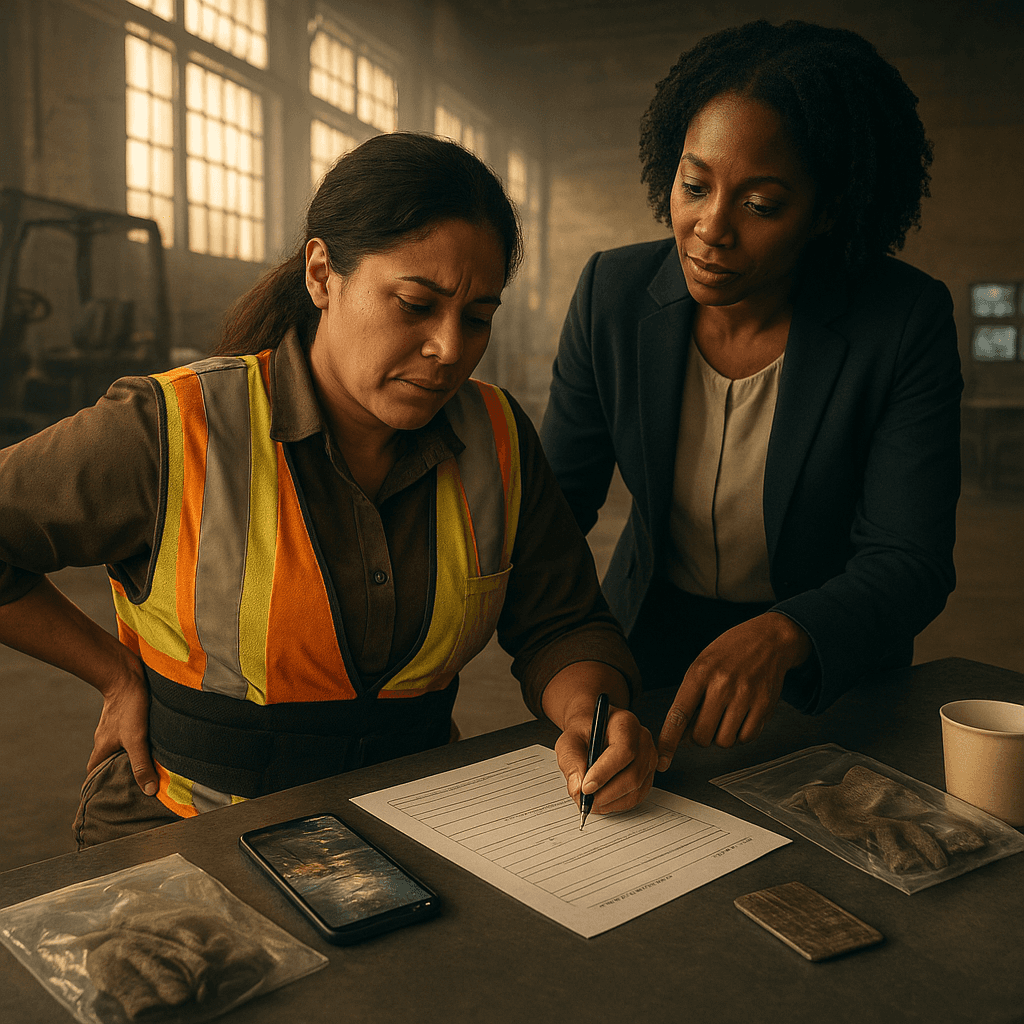
Estimated reading time: 16 minutes
Key Takeaways
Unwitnessed claims turn on credibility and causation. You can win by documenting objective medical findings, preserving physical and electronic proof, and keeping consistent accounts.
Act fast: get medical care that explicitly states “work-related,” report the injury in writing, preserve clothing/PPE/tools, request CCTV, and start contemporaneous notes.
Use a comprehensive evidence mix: medical records, photos/videos, timecards and GPS logs, maintenance records, prior hazard reports, and coworker corroboration.
Build a persuasive narrative: clear mechanism of injury + timeline + medical opinion linking diagnosis to the event meets the “more likely than not” standard in most workers’ comp cases.
If denied due to “no witnesses,” assemble additional proof, request reconsideration, and file an appeal within deadlines. Consider expert opinions and subpoenas for surveillance/electronic data.
Keep copies, preserve metadata, and maintain chain of custody. Timely, consistent documentation is often the decisive factor.
Table of Contents
Key Takeaways
Introduction
Why Unwitnessed Claims Are Challenging
Immediate Steps After an Unwitnessed Workplace Injury — Action Checklist
Evidence You Can Use When There Were No Witnesses
Objective Medical Evidence
Environmental Evidence
Electronic Evidence
Corroborating Documentation
Written Coworker Statements
How to Document an Unwitnessed Accident at the Worksite
No Witness Work Injury Claim — Incident Report Template
Photo and Video Checklist
Timestamping and Digital Best Practices
Retaining Physical Evidence and Chain of Custody
CCTV Preservation Request Template
Coworker Corroboration Request
Upload and Backup Instructions
Building a Narrative & Proving Medical Causation
Step 1 — Create a Timeline
Step 2 — Mechanism of Injury
Step 3 — Connect to Medical Records
Step 4 — When to Get an IME or Second Opinion
Sample Persuasive Phrases for Causation
If Your Claim Was Denied — Appeals & Next Steps
Common Denial Reasons
Appeals Roadmap
Evidence Strategy for Hearing
Surveillance and CCTV Subpoenas
Conflicting Medical Opinions
When to Hire an Attorney
Sample Letters — Reconsideration and Subpoena Language
Real-Life Examples / Mini Case Studies
Preventative Tips for Workers and Employers
Checklist & Templates You Can Copy
Closing / Next Steps
Conclusion
FAQ
Can I get injured alone on the job compensation without witnesses?
What to do if workers comp denied no witnesses?
How strong must my evidence be to prove a no witness work injury claim?
How long do I have to report an unwitnessed accident documentation worksite?
Introduction
No witness work injury claim: If you were injured alone on the job, this guide shows exactly how to prove your accident, collect evidence, and get compensation. Being the only person present can feel isolating, but with the right proof, an unwitnessed accident can still qualify for injured alone on the job compensation.
In this article, you’ll learn the immediate steps to take, the exact types of evidence that persuade adjusters and judges, how to organize your documentation, what to do if you’re denied, and when to consider an attorney. You’ll also find copyable templates for incident reports, coworker corroboration, medical documentation requests, CCTV preservation emails, reconsideration letters, and subpoena language.
Good news about the burden of proof: workers’ compensation typically requires proof by a preponderance of the evidence (more likely than not), which is a lower standard than many civil cases. Both this explanation of what to do if there were no witnesses and guidance on workers’ comp claims with no witnesses confirm that you do not need to eliminate all doubt—only show it’s more likely your injury happened at work.
Why Unwitnessed Claims Are Challenging
Unwitnessed claims are harder because insurers focus on credibility and work-related causation when no one saw the accident. Denials often follow patterns. Understanding them helps you prepare stronger evidence and keep your story consistent across every form, medical visit, and conversation.
Credibility concerns: Adjusters scrutinize inconsistent descriptions, vague timelines, or delayed symptom reporting. Guidance on what if no one witnessed your workplace accident and this discussion of no-witness claims both note that credibility gaps can sink a claim even when the injury is real.
Conflicting accounts: Employer or coworker statements may suggest a different cause, such as a non-work activity, or claim the hazard didn’t exist. See how employer and coworker statements factor into workers’ comp cases.
Pre-existing conditions: Insurers may argue your condition predated work or arose elsewhere. You can rebut this by showing baseline medical records and a physician’s opinion linking the mechanism of injury to your diagnosis, an approach reinforced in guidance on unwitnessed claims.
Adjuster tactics: Expect detailed interrogations about timing and mechanism, requests for non-work medical records, and pressure to return to work before appropriate assessment—tactics highlighted in both no-witness injury guidance and no-witness claim strategies.
If your workers comp denied no witnesses scenario stems from these issues, do not panic. Remain consistent in every account, avoid oversharing unrelated history, and write contemporaneous notes right away. A strong, documented narrative often turns a no witness work injury claim from doubtful to credible.
For more background on insurer behavior and common denial tactics, review why employers deny workers’ comp and how to respond in this overview of common denial reasons and your rights.
Immediate Steps After an Unwitnessed Workplace Injury — Action Checklist
Acting fast preserves evidence and strengthens eligibility for injured alone on the job compensation. Physical conditions change quickly, CCTV is overwritten, and reporting windows can be short. As one state example, the New York Workers’ Compensation Board explains prompt notice expectations and consequences on its page about what employers and workers should do when an injury happens.
Seek medical care now. Tell medical staff exactly that the injury occurred at work. Describe the mechanism: what you were lifting, where you slipped, or what struck you. Ask the provider to document “work-related” in the visit note and include objective findings (swelling, reduced range of motion, wounds, imaging). This is echoed in guidance on what to do if there were no witnesses, in unwitnessed accident steps, and in this overview of what to do if no one witnessed your work injury.
Report the injury to your employer immediately and in writing. If your state sets a reporting deadline, missing it can block benefits; see the New York Board’s explanation of when and how to report. Use the incident report template below to ensure you include all required facts.
Preserve physical evidence. Unwitnessed accident documentation worksite begins with your hands-on items: place clothing, PPE, and tools in labeled bags; do not wash clothing; photograph items before bagging. Stains, tears, and contaminants can corroborate your account.
Start contemporaneous notes. Immediately write the date/time, exact location (building/floor/zone), minute-by-minute sequence of events, symptom onset, and what you did after. These notes carry weight if created right away, as discussed in no-witness best practices and unwitnessed claim strategies.
File a written incident report. Include all injured body parts, a clear mechanism, and any equipment or environmental conditions involved, as recommended in guidance on unwitnessed workers’ comp claims.
Sample contemporaneous journal entry (example format):
“04/12/2025, 10:18 a.m. — Warehouse B, Aisle 7 near conveyor. While lifting a 50 lb crate from pallet A to conveyor B, felt a sharp pain in lower back; had to set crate down and could not stand fully upright. Reported to supervisor at 10:26 a.m.; clocked out at 10:35 a.m. Went to urgent care at 11:10 a.m.”
For broader context on early steps, see this step-by-step guide to what to do after a workplace injury and this overview on how to file a workers’ compensation claim.
Evidence You Can Use When There Were No Witnesses
When no one saw the event, your case relies on objective, corroborating, and electronic evidence. Both no-witness comp strategies and this discussion on handling an injury case without witnesses stress that proving unwitnessed injury at work often comes down to neutral records and data.
Objective Medical Evidence
What it is: Imaging (X-ray, MRI), exam findings (swelling, reduced range of motion, neurological deficits), visible wounds, prescriptions, referrals, physical therapy progress notes, and consistent follow-up visits.
Why it helps: It shows a diagnosable condition matching your mechanism. Objective findings reduce disputes about credibility and support proving unwitnessed injury at work.
How to get it and what to ask for: Ask your doctor to explicitly connect the mechanism to your diagnosis using language medical boards recognize. Resources on documenting unwitnessed accidents, no-witness claims, and objective proof without witnesses emphasize this point.
Sample sentence you can request your provider include:
“Patient reports lifting a 50 lb crate with immediate onset of sharp low back pain. Clinical findings (lumbar paraspinal tenderness, reduced flexion) and MRI (L4-5 disc herniation) are consistent with a work-related acute lumbar strain and disc injury.”
How to use in your claim/appeal: “My treating physician documented objective findings and imaging consistent with my mechanism, supporting that it is more likely than not the injury occurred at work.”
Environmental Evidence
What it is: Photos/videos of the scene, broken equipment, spills, worn floor markings, damaged guards; facility maps/floor plans; hazard and maintenance logs.
Why it helps: Shows the hazard existed and matches your account.
How to get it: Ask the safety officer for inspection/maintenance logs. If needed, counsel can request floor plans and hazard records. Guidance in unwitnessed claim best practices and the role of workplace records and witnesses explains how facility documentation supports causation.
Sample request for maintenance logs (send to safety/maintenance):
“Please provide maintenance/inspection logs for Conveyor B and Aisle 7 floor surfaces for 03/01/2025–04/12/2025, including any work orders, hazard reports, or corrective actions. These records may corroborate the hazardous condition present at the time of my injury.”
Electronic Evidence
What it is: Timecards, swipe/badge entries, GPS route data, machine/device logs, delivery logs, and CCTV footage.
Why it helps: It independently shows you were where you said you were, doing the task you described at the time you reported. For CCTV, act quickly because systems overwrite footage—see preservation tips for no-witness claims.
How to request CCTV and logs: Send a written preservation request the same day you report the incident; follow up regularly. If needed later, subpoena relevant footage and logs.
Sample email to request CCTV preservation:
“Please preserve all CCTV footage from cameras covering Warehouse B, Aisle 7 and the Conveyor B loading area between 10:00 a.m. and 11:00 a.m. on 04/12/2025, and confirm preservation in writing.”
How to use in your claim/appeal: “Timecard and swipe entries place me at the scene; GPS and CCTV corroborate my presence and activity, supporting proving unwitnessed injury at work through electronic data.”
Corroborating Documentation
What it is: Prior hazard reports, near-miss logs, safety meeting minutes, corrective action records, and incident history for the area or device. These materials can show a known hazard and bolster your account, as explained in analyses of how records and witnesses influence claims and this discussion of how witness-related proof impacts claims.
Sample tie-in paragraph for your claim:
“The employer’s safety meeting minutes from March list repeated slipping hazards near Conveyor B; maintenance logs show multiple requests to address worn floor markings. These records corroborate the hazardous condition that caused my fall on 04/12/2025.”
Written Coworker Statements
What they are: Short, factual statements from coworkers who saw you before/after the incident, observed your condition, or can confirm a hazard. They need not be eyewitnesses to be helpful.
Template (1–2 short paragraphs):
“Date/Time: 04/12/2025, approx. 10:25 a.m.; Location: Warehouse B, Aisle 7. I saw [Name] holding his lower back, moving slowly, and leaning on the rail near Conveyor B. The floor was slick near the pallet area. I did not see the moment of injury, but I observed his condition immediately afterward.
Signature/Printed Name/Contact Info/Job Title.”
For more on building your evidence file, see this practical guide to documenting a work injury.
How to Document an Unwitnessed Accident at the Worksite
Think of “unwitnessed accident documentation worksite” as one dated, reproducible package containing your incident report, photos/videos, contemporaneous notes, preserved physical evidence, electronic logs, and corroborating statements—organized and ready to submit.
No Witness Work Injury Claim — Incident Report Template
Header fields:
Employee Name
Job Title
Supervisor
Date/Time of Incident
Location (Building/Zone/Coordinate)
Shift (start/end)
Sequence of events (first-person, factual, minute-by-minute if possible):
10:16 — Retrieved 50 lb crate from pallet A in Aisle 7.
10:18 — While lifting crate from pallet A to Conveyor B, felt sharp pain in lower back; set crate down; could not fully straighten.
10:20 — Notified coworker; moved to rail to rest; pain persisted.
Task immediately before incident: e.g., “Loading cartons from pallet A to Conveyor B.”
Mechanism of injury (use precise language): “While lifting a 50 lb crate from pallet A to Conveyor B, I felt a sharp pain in my lower back and could not stand fully upright.” (Use similar precise phrasing for falls, twists, impacts.)
Injured body parts and symptoms: e.g., “Low back; sharp pain; limited range of motion; muscle spasm.”
First aid rendered: e.g., “Ice applied; rested off feet.”
Witness list: Include anyone who saw you before/after or can confirm hazards.
Equipment involved (serials): e.g., “Conveyor B; Pallet Jack #PJ-217.”
Environmental conditions: e.g., “Worn floor markings; slick area near pallet staging.”
Signature/Date.
Sample two-line narrative:
“While lifting a 50 lb crate from pallet A to Conveyor B at 10:18 a.m., I felt a sharp pain in my lower back and could not stand upright. I reported to my supervisor within minutes and sought medical care the same morning.”
After submitting your report at work, email a copy to yourself to preserve a time-stamped record of contemporaneous filing. For state reporting details and why timing matters, review state board explanations of notice requirements.
Photo and Video Checklist
Wide shot showing the entire area and landmarks (context).
Mid-range shot showing equipment and surroundings.
Close-ups of hazard (puddle, frayed cord, damaged guard).
Close-ups of injured areas and PPE condition (tears, missing components).
Photos of relevant signage and floor markings.
At least one photo with a timestamped item (phone screen with time + a ruler or ID badge in frame).
Guidance: Capture multiple angles, keep originals, export copies for submission. These practices strengthen an unwitnessed accident documentation worksite package.
Timestamping and Digital Best Practices
Preserve metadata by keeping originals on your device/cloud and avoiding edits that strip EXIF data. Create a simple “photo log” for each file.
Photo log CSV headers: Filename | Date/Time | Location | Subject | Photographer | Notes
Retaining Physical Evidence and Chain of Custody
Place clothing/PPE/tools in labeled paper or evidence bags; do not use plastic if items are wet. Note date/time collected and who took possession. Maintain a chain-of-custody log to show authenticity from collection to hearing, a key practice endorsed in guidance on handling injury cases without witnesses.
Chain-of-custody log fields: Item ID | Description | Collected by | Date/Time | Transferred to | Purpose
CCTV Preservation Request Template
Because CCTV is often overwritten, send a written request immediately. As urged in no-witness claim resources:
Email (two short paragraphs + demand line):
“I sustained a work injury on [date/time] in [location]. This email requests immediate preservation of video and related electronic data that may show the incident, the area, and my presence.
Please preserve all CCTV footage from cameras covering [area] between [date/time] and [date/time] and confirm preservation in writing.”
Mention that this request is part of your unwitnessed accident documentation worksite file, and keep proof of your request.
Coworker Corroboration Request
For coworkers unwilling to write full statements, offer this exact two-sentence option:
“I saw [name] at [time] near [location] and observed [fact]. I am willing to provide a written statement if requested.”
Upload and Backup Instructions
Save files to a personal email or secure cloud account with two-factor authentication; print hard copies. Keep originals intact. Organize your folder with subfolders labeled Incident Report, Photos, Video Requests, Medical, Logs, and Statements. These steps support proving unwitnessed injury at work by making your record complete and retrievable.
Building a Narrative & Proving Medical Causation
Your claim succeeds when medical findings + a clear mechanism + contemporaneous evidence form a persuasive narrative. Weave your documents into a single story that shows what happened and why your diagnosis matches it.
Step 1 — Create a Timeline
Create a worksheet with columns: Date | Time | Task | Location | Symptoms/Events | Evidence (photos/logs/doctor visits). Keep it concise.
Sample timeline (lift/back pain):
04/12/2025 | 10:16 | Loading crates | Warehouse B, Aisle 7 | No symptoms | Timecard + swipe log
04/12/2025 | 10:18 | Lifted 50 lb crate | Same | Sharp low back pain | Photo of area; contemporaneous note
04/12/2025 | 11:10 | Urgent care | Clinic | Exam shows reduced ROM; MRI ordered | Medical records
Step 2 — Mechanism of Injury
The mechanism phrase is your one-sentence “how” statement. Examples you can adapt for your incident report and doctor visits:
Fall: “While stepping around a pallet on a slick floor, my right foot slipped, causing a fall onto my right hip and elbow.”
Repetitive motion: “After weeks of scanning and shelving packages above shoulder height, I developed progressive right shoulder pain consistent with overuse.”
Acute lift: “While pushing a loaded cart over an uneven threshold, my left foot caught the lip, causing a twist and acute right ankle sprain.”
Step 3 — Connect to Medical Records
Ask your treating physician to use precise causation language. You can bring these sample phrases to your appointment:
History of present illness: “Patient reports incident described above. Symptoms began immediately after the incident.”
Opinion statement: “It is my medical opinion, to a reasonable degree of medical certainty, that the patient’s [diagnosis] is causally related to the above-described work incident.”
Sample medical request language for your doctor (two short paragraphs):
“Doctor, please document that my injury occurred during a specific work task, and note objective clinical findings and imaging. Please include whether these findings are consistent with the reported mechanism.”
“If you agree, please state your medical opinion that, to a reasonable degree of medical certainty, my diagnosis is causally related to the work incident described.”
Step 4 — When to Get an IME or Second Opinion
Insurers sometimes order an Independent Medical Exam (IME) to challenge causation. Consider a second opinion if an insurer IME contradicts your treating doctor. Experts in occupational medicine, orthopedics, or biomechanics may help clarify complex causation, as noted in guidance on injury cases without witnesses and in no-witness workers’ comp advice.
Sample Persuasive Phrases for Causation
“The mechanism (acute lift) and immediate onset of symptoms align with MRI-confirmed lumbar disc injury.”
“Objective exam findings and imaging are consistent with a work-related diagnosis, making work causation more likely than not.”
“Timecard, swipe logs, and photos independently corroborate my presence and task at the reported time.”
“Prior hazard reports show this condition pre-existed the incident and plausibly caused my injury.”
“My medical history shows no prior condition; baseline records support a new work-related injury.”
“Treating physician provides a reasoned medical opinion linking diagnosis to the described mechanism.”
“Even without eyewitnesses, objective and electronic evidence supports proving unwitnessed injury at work.”
“The totality of evidence meets the preponderance standard required in workers’ compensation.”
To understand deadlines that affect medical opinions and filings, review this guide to the workers’ comp time limit to file.
If Your Claim Was Denied — Appeals & Next Steps
“Workers comp denied no witnesses” describes a common denial scenario where adjusters highlight credibility or causation gaps. Typical denial reasons include late reporting, insufficient medical causation, pre-existing condition arguments, or conflicting accounts. See this discussion of how to handle unwitnessed injury denials and evidence gaps.
Common Denial Reasons
Reported late or not in writing
No clear mechanism or lack of objective medical findings
Inconsistent accounts across forms, medical notes, and adjuster calls
Pre-existing condition theories unsupported by your baseline records
Appeals Roadmap
Request reconsideration or submit a disagreement notice quickly. Provide newly gathered evidence and restate the mechanism clearly. Include a renewed preservation request for CCTV and logs.
File a formal appeal/hearing request within the statutory window. Typical attachments include your incident report, medical records, photo log, coworker statements, and timecard/log data. For state process examples, see the New York Board’s explanation of reporting and employer responsibilities.
Organize your file. Use a chronology and exhibit list so a judge can follow your narrative quickly. Consider using the timeline and photo-log formats in this article.
For a broader playbook on challenging a denial, see this step-by-step guide to appealing a workers’ comp denial.
Evidence Strategy for Hearing
Prioritize objective medical proof, electronic data (CCTV, machine/time logs), and sworn statements. Consider expert witnesses:
Occupational medicine/orthopedics: Causation, impairment, and work restrictions.
Safety engineer: Hazard identification, compliance, and feasible controls.
Biomechanics expert: How the forces of the task plausibly caused your specific injury.
These strategies mirror recommendations for unwitnessed cases in handling injury cases without witnesses.
Surveillance and CCTV Subpoenas
If informal requests fail, ask your attorney about subpoenas. Move fast—CCTV retention windows can be short, and delivery/GPS logs may be purged. You can learn more about how video is used in claims and how to respond in this overview of workers’ comp surveillance video issues.
Conflicting Medical Opinions
When an insurer IME conflicts with your treating doctor, prepare a medical chronology summarizing symptoms, exams, imaging, and treatment over time. Cross-examine on objective findings and consistency. Use prior records to show your baseline and rebut pre-existing condition theories.
When to Hire an Attorney
Consider counsel when causation is complex, wage loss is substantial, initial proof didn’t resolve the denial, or IME conflicts arise. A lawyer can gather experts, file appeals, prepare chronologies, and represent you at hearings. See practical advice in what to do when there were no witnesses and this overview of no-witness workers’ comp strategies. For a strategic overview of legal help and timing, review this guide on when to hire a workers’ comp lawyer.
Sample Letters — Reconsideration and Subpoena Language
Reconsideration request (short, boilerplate):
“Re: Claim No. [#] — Request for Reconsideration
I respectfully request reconsideration of the denial dated [date]. Enclosed are additional materials, including objective medical findings linking my diagnosis to the work incident, contemporaneous notes, timecard/GPS logs, and a photo log of the hazard area. These records support that it is more likely than not my injury occurred at work. Please also confirm preservation of CCTV for [area] from [date/time] to [date/time].”
Subpoena request sample wording (for counsel to adapt):
“Please issue a subpoena duces tecum commanding [Employer/Facility] to produce all CCTV footage covering [area] for [date/time range], and electronic logs (timecard/badge access, machine logs, GPS/delivery records) reflecting [Worker’s Name] presence and activity during the same period.”
Real-Life Examples / Mini Case Studies
Case 1 — Medical Evidence + Notes, Approved on Appeal
Pattern: Proving unwitnessed injury at work through medical proof and contemporaneous documentation.
A warehouse technician felt acute low-back pain during a morning lift. No one saw the moment of injury. He reported immediately, documented the area with photos, and sought care the same day. Imaging showed a disc herniation; exam notes recorded reduced range of motion. His doctor included a causation statement linking the lift mechanism to diagnosis. The initial claim was denied for lack of witnesses, but on appeal he submitted a medical chronology, the incident report, and his contemporaneous notes. Drawing on strategies similar to unwitnessed claim guidance and advice on what to do when there were no witnesses, the appeal board found the evidence met the preponderance standard and approved benefits.
Takeaway: Objective imaging + exam findings can outweigh lack of eyewitnesses.
Takeaway: Contemporaneous notes and prompt reporting bolster credibility.
Takeaway: A doctor’s causation opinion is often decisive.
Case 2 — Electronic Logs + CCTV
Pattern: Timecards/GPS and preserved CCTV establish presence and activity.
A delivery driver slipped exiting a loading bay. No coworker saw the fall, but GPS and timecard logs confirmed location/time. A swift written request preserved CCTV before it was overwritten. The footage showed the driver entering the slick area moments before the reported time. With medical records and an incident report using precise mechanism language, the claim was approved. These steps align with no-witness evidence strategies.
Takeaway: Electronic records can substitute for missing eyewitnesses.
Takeaway: Immediate CCTV preservation requests are critical.
Takeaway: Specific mechanism language ties video to medical findings.
Case 3 — Expert Testimony on Repetitive Trauma
Pattern: Biomechanics + occupational medicine link repetitive tasks to diagnosis.
An assembly worker developed shoulder tendinopathy over months. With no single incident or witnesses, a biomechanics expert analyzed force, repetition, and posture demands; an occupational medicine specialist corroborated causation based on exam and imaging. Drawing on best practices for unwitnessed cases described in injury-without-witnesses guidance, the experts testified the work activities were the more likely cause. The judge credited objective reports and expert analysis.
Takeaway: Experts can translate job demands into credible causation evidence.
Takeaway: Longitudinal medical records and consistent complaints matter.
Takeaway: A no witness work injury claim can win on cumulative proof.
Preventative Tips for Workers and Employers
Practical Tips for Workers
Report incidents immediately, in writing.
Take photos routinely of hazard areas and equipment.
Preserve PPE and work clothing after incidents.
Keep daily work notes of tasks, locations, and symptoms.
Know where cameras are and request footage quickly if injured.
Request copies of logs (timecard, maintenance) promptly to support injured alone on the job compensation claims.
Practical Tips for Employers
Maintain CCTV with reasonable retention and clear request procedures; promptly preserve footage upon notice of an incident.
Train supervisors on immediate incident reporting and objective documentation.
Keep maintenance and tool logs current and accessible.
Encourage prompt reporting without retaliation.
Document hazard corrections and safety meetings.
Honor preservation requests to support an unwitnessed accident documentation worksite record if a claim arises.
Checklist & Templates You Can Copy
Use this section to assemble your own folder. It is not a download; copy the items below into your notes app or documents so they are ready if needed.
No Witness Work Injury Claim — Checklist (one page): Immediate actions; evidence list (medical, environmental, electronic); incident report fields; photo checklist; timeline worksheet columns.
Incident report template (fillable in your notes): Include all fields listed earlier and the sample two-line narrative.
Photo checklist (printable in your notes): The camera-angle list above with a place for timestamps.
Timeline worksheet (simple table): Date | Time | Task | Location | Symptoms/Events | Evidence.
Contemporaneous journal samples: Acute lift and delayed-onset entries.
Coworker statement template: Two-paragraph factual format.
CCTV preservation email: Two short paragraphs with the preservation demand line.
Reconsideration letter and subpoena wording: Short, boilerplate text to guide your next steps with counsel.
If you need a refresher on the overall claim process and benefits, see how to file a workers’ comp claim and what benefits workers’ comp covers.
Closing / Next Steps
Protect your claim by doing four things well: seek medical care that documents “work-related,” report in writing right away, preserve all forms of evidence (photos, PPE, logs, CCTV), and keep a consistent, detailed record. Evidence can disappear quickly—CCTV is often overwritten, and conditions change—so move within hours or days, not weeks.
If your claim faces questions, these resources can help you prepare and stay organized: how to document a work injury, why employers deny claims, and how to appeal a denial.
Conclusion
A thoughtful, well-documented record can overcome the absence of eyewitnesses. Build your credibility through immediate medical care and consistent reporting; build your causation through objective findings, precise mechanism language, and corroborating electronic and environmental evidence. Even with a no witness work injury claim, your file can meet the “more likely than not” standard when the pieces fit together.
This article is informational and not legal advice; consult an attorney for advice tailored to your state and situation. Rules and timelines vary, and “workers comp denied no witnesses” outcomes depend on your specific facts and local law.
Need help now? Get a free and instant case evaluation by US Work Accident Lawyers. See if your case qualifies within 30-seconds at https://usworkaccidentlawyer.com.
FAQ
Can I get injured alone on the job compensation without witnesses?
Yes. Workers’ comp generally uses the “preponderance of the evidence” standard—more likely than not—so eyewitnesses aren’t required if you have other proof. Prioritize medical records linking diagnosis to your mechanism, electronic logs (timecards/GPS), and clear scene photos, as explained in guidance on what to do if there were no witnesses and unwitnessed accident documentation.
What to do if workers comp denied no witnesses?
Gather additional evidence (objective medical findings, CCTV, timecards, maintenance logs), request reconsideration, and file an appeal within deadlines. Consider expert support if causation is disputed. See evidence and appeal strategies in how to handle an injury without witnesses.
How strong must my evidence be to prove a no witness work injury claim?
You must meet the preponderance standard: show it’s more likely than not your injury occurred at work. Example combinations that often suffice include medical proof plus contemporaneous notes, or medical proof plus CCTV/timecard logs, as noted in no-witness guidance and this overview of no-witness comp claims.
How long do I have to report an unwitnessed accident documentation worksite?
Many states require prompt notice, often within days up to around 10 days, and delays can lead to denial. Always check your state’s rules; as one example, see the New York Board’s page on what to do when an injury happens.
For more information about filing steps and timelines, visit this practical guide to filing a workers’ comp claim.
Estimated reading time: 16 minutes
Key Takeaways
Unwitnessed claims turn on credibility and causation. You can win by documenting objective medical findings, preserving physical and electronic proof, and keeping consistent accounts.
Act fast: get medical care that explicitly states “work-related,” report the injury in writing, preserve clothing/PPE/tools, request CCTV, and start contemporaneous notes.
Use a comprehensive evidence mix: medical records, photos/videos, timecards and GPS logs, maintenance records, prior hazard reports, and coworker corroboration.
Build a persuasive narrative: clear mechanism of injury + timeline + medical opinion linking diagnosis to the event meets the “more likely than not” standard in most workers’ comp cases.
If denied due to “no witnesses,” assemble additional proof, request reconsideration, and file an appeal within deadlines. Consider expert opinions and subpoenas for surveillance/electronic data.
Keep copies, preserve metadata, and maintain chain of custody. Timely, consistent documentation is often the decisive factor.
Table of Contents
Key Takeaways
Introduction
Why Unwitnessed Claims Are Challenging
Immediate Steps After an Unwitnessed Workplace Injury — Action Checklist
Evidence You Can Use When There Were No Witnesses
Objective Medical Evidence
Environmental Evidence
Electronic Evidence
Corroborating Documentation
Written Coworker Statements
How to Document an Unwitnessed Accident at the Worksite
No Witness Work Injury Claim — Incident Report Template
Photo and Video Checklist
Timestamping and Digital Best Practices
Retaining Physical Evidence and Chain of Custody
CCTV Preservation Request Template
Coworker Corroboration Request
Upload and Backup Instructions
Building a Narrative & Proving Medical Causation
Step 1 — Create a Timeline
Step 2 — Mechanism of Injury
Step 3 — Connect to Medical Records
Step 4 — When to Get an IME or Second Opinion
Sample Persuasive Phrases for Causation
If Your Claim Was Denied — Appeals & Next Steps
Common Denial Reasons
Appeals Roadmap
Evidence Strategy for Hearing
Surveillance and CCTV Subpoenas
Conflicting Medical Opinions
When to Hire an Attorney
Sample Letters — Reconsideration and Subpoena Language
Real-Life Examples / Mini Case Studies
Preventative Tips for Workers and Employers
Checklist & Templates You Can Copy
Closing / Next Steps
Conclusion
FAQ
Can I get injured alone on the job compensation without witnesses?
What to do if workers comp denied no witnesses?
How strong must my evidence be to prove a no witness work injury claim?
How long do I have to report an unwitnessed accident documentation worksite?
Introduction
No witness work injury claim: If you were injured alone on the job, this guide shows exactly how to prove your accident, collect evidence, and get compensation. Being the only person present can feel isolating, but with the right proof, an unwitnessed accident can still qualify for injured alone on the job compensation.
In this article, you’ll learn the immediate steps to take, the exact types of evidence that persuade adjusters and judges, how to organize your documentation, what to do if you’re denied, and when to consider an attorney. You’ll also find copyable templates for incident reports, coworker corroboration, medical documentation requests, CCTV preservation emails, reconsideration letters, and subpoena language.
Good news about the burden of proof: workers’ compensation typically requires proof by a preponderance of the evidence (more likely than not), which is a lower standard than many civil cases. Both this explanation of what to do if there were no witnesses and guidance on workers’ comp claims with no witnesses confirm that you do not need to eliminate all doubt—only show it’s more likely your injury happened at work.
Why Unwitnessed Claims Are Challenging
Unwitnessed claims are harder because insurers focus on credibility and work-related causation when no one saw the accident. Denials often follow patterns. Understanding them helps you prepare stronger evidence and keep your story consistent across every form, medical visit, and conversation.
Credibility concerns: Adjusters scrutinize inconsistent descriptions, vague timelines, or delayed symptom reporting. Guidance on what if no one witnessed your workplace accident and this discussion of no-witness claims both note that credibility gaps can sink a claim even when the injury is real.
Conflicting accounts: Employer or coworker statements may suggest a different cause, such as a non-work activity, or claim the hazard didn’t exist. See how employer and coworker statements factor into workers’ comp cases.
Pre-existing conditions: Insurers may argue your condition predated work or arose elsewhere. You can rebut this by showing baseline medical records and a physician’s opinion linking the mechanism of injury to your diagnosis, an approach reinforced in guidance on unwitnessed claims.
Adjuster tactics: Expect detailed interrogations about timing and mechanism, requests for non-work medical records, and pressure to return to work before appropriate assessment—tactics highlighted in both no-witness injury guidance and no-witness claim strategies.
If your workers comp denied no witnesses scenario stems from these issues, do not panic. Remain consistent in every account, avoid oversharing unrelated history, and write contemporaneous notes right away. A strong, documented narrative often turns a no witness work injury claim from doubtful to credible.
For more background on insurer behavior and common denial tactics, review why employers deny workers’ comp and how to respond in this overview of common denial reasons and your rights.
Immediate Steps After an Unwitnessed Workplace Injury — Action Checklist
Acting fast preserves evidence and strengthens eligibility for injured alone on the job compensation. Physical conditions change quickly, CCTV is overwritten, and reporting windows can be short. As one state example, the New York Workers’ Compensation Board explains prompt notice expectations and consequences on its page about what employers and workers should do when an injury happens.
Seek medical care now. Tell medical staff exactly that the injury occurred at work. Describe the mechanism: what you were lifting, where you slipped, or what struck you. Ask the provider to document “work-related” in the visit note and include objective findings (swelling, reduced range of motion, wounds, imaging). This is echoed in guidance on what to do if there were no witnesses, in unwitnessed accident steps, and in this overview of what to do if no one witnessed your work injury.
Report the injury to your employer immediately and in writing. If your state sets a reporting deadline, missing it can block benefits; see the New York Board’s explanation of when and how to report. Use the incident report template below to ensure you include all required facts.
Preserve physical evidence. Unwitnessed accident documentation worksite begins with your hands-on items: place clothing, PPE, and tools in labeled bags; do not wash clothing; photograph items before bagging. Stains, tears, and contaminants can corroborate your account.
Start contemporaneous notes. Immediately write the date/time, exact location (building/floor/zone), minute-by-minute sequence of events, symptom onset, and what you did after. These notes carry weight if created right away, as discussed in no-witness best practices and unwitnessed claim strategies.
File a written incident report. Include all injured body parts, a clear mechanism, and any equipment or environmental conditions involved, as recommended in guidance on unwitnessed workers’ comp claims.
Sample contemporaneous journal entry (example format):
“04/12/2025, 10:18 a.m. — Warehouse B, Aisle 7 near conveyor. While lifting a 50 lb crate from pallet A to conveyor B, felt a sharp pain in lower back; had to set crate down and could not stand fully upright. Reported to supervisor at 10:26 a.m.; clocked out at 10:35 a.m. Went to urgent care at 11:10 a.m.”
For broader context on early steps, see this step-by-step guide to what to do after a workplace injury and this overview on how to file a workers’ compensation claim.
Evidence You Can Use When There Were No Witnesses
When no one saw the event, your case relies on objective, corroborating, and electronic evidence. Both no-witness comp strategies and this discussion on handling an injury case without witnesses stress that proving unwitnessed injury at work often comes down to neutral records and data.
Objective Medical Evidence
What it is: Imaging (X-ray, MRI), exam findings (swelling, reduced range of motion, neurological deficits), visible wounds, prescriptions, referrals, physical therapy progress notes, and consistent follow-up visits.
Why it helps: It shows a diagnosable condition matching your mechanism. Objective findings reduce disputes about credibility and support proving unwitnessed injury at work.
How to get it and what to ask for: Ask your doctor to explicitly connect the mechanism to your diagnosis using language medical boards recognize. Resources on documenting unwitnessed accidents, no-witness claims, and objective proof without witnesses emphasize this point.
Sample sentence you can request your provider include:
“Patient reports lifting a 50 lb crate with immediate onset of sharp low back pain. Clinical findings (lumbar paraspinal tenderness, reduced flexion) and MRI (L4-5 disc herniation) are consistent with a work-related acute lumbar strain and disc injury.”
How to use in your claim/appeal: “My treating physician documented objective findings and imaging consistent with my mechanism, supporting that it is more likely than not the injury occurred at work.”
Environmental Evidence
What it is: Photos/videos of the scene, broken equipment, spills, worn floor markings, damaged guards; facility maps/floor plans; hazard and maintenance logs.
Why it helps: Shows the hazard existed and matches your account.
How to get it: Ask the safety officer for inspection/maintenance logs. If needed, counsel can request floor plans and hazard records. Guidance in unwitnessed claim best practices and the role of workplace records and witnesses explains how facility documentation supports causation.
Sample request for maintenance logs (send to safety/maintenance):
“Please provide maintenance/inspection logs for Conveyor B and Aisle 7 floor surfaces for 03/01/2025–04/12/2025, including any work orders, hazard reports, or corrective actions. These records may corroborate the hazardous condition present at the time of my injury.”
Electronic Evidence
What it is: Timecards, swipe/badge entries, GPS route data, machine/device logs, delivery logs, and CCTV footage.
Why it helps: It independently shows you were where you said you were, doing the task you described at the time you reported. For CCTV, act quickly because systems overwrite footage—see preservation tips for no-witness claims.
How to request CCTV and logs: Send a written preservation request the same day you report the incident; follow up regularly. If needed later, subpoena relevant footage and logs.
Sample email to request CCTV preservation:
“Please preserve all CCTV footage from cameras covering Warehouse B, Aisle 7 and the Conveyor B loading area between 10:00 a.m. and 11:00 a.m. on 04/12/2025, and confirm preservation in writing.”
How to use in your claim/appeal: “Timecard and swipe entries place me at the scene; GPS and CCTV corroborate my presence and activity, supporting proving unwitnessed injury at work through electronic data.”
Corroborating Documentation
What it is: Prior hazard reports, near-miss logs, safety meeting minutes, corrective action records, and incident history for the area or device. These materials can show a known hazard and bolster your account, as explained in analyses of how records and witnesses influence claims and this discussion of how witness-related proof impacts claims.
Sample tie-in paragraph for your claim:
“The employer’s safety meeting minutes from March list repeated slipping hazards near Conveyor B; maintenance logs show multiple requests to address worn floor markings. These records corroborate the hazardous condition that caused my fall on 04/12/2025.”
Written Coworker Statements
What they are: Short, factual statements from coworkers who saw you before/after the incident, observed your condition, or can confirm a hazard. They need not be eyewitnesses to be helpful.
Template (1–2 short paragraphs):
“Date/Time: 04/12/2025, approx. 10:25 a.m.; Location: Warehouse B, Aisle 7. I saw [Name] holding his lower back, moving slowly, and leaning on the rail near Conveyor B. The floor was slick near the pallet area. I did not see the moment of injury, but I observed his condition immediately afterward.
Signature/Printed Name/Contact Info/Job Title.”
For more on building your evidence file, see this practical guide to documenting a work injury.
How to Document an Unwitnessed Accident at the Worksite
Think of “unwitnessed accident documentation worksite” as one dated, reproducible package containing your incident report, photos/videos, contemporaneous notes, preserved physical evidence, electronic logs, and corroborating statements—organized and ready to submit.
No Witness Work Injury Claim — Incident Report Template
Header fields:
Employee Name
Job Title
Supervisor
Date/Time of Incident
Location (Building/Zone/Coordinate)
Shift (start/end)
Sequence of events (first-person, factual, minute-by-minute if possible):
10:16 — Retrieved 50 lb crate from pallet A in Aisle 7.
10:18 — While lifting crate from pallet A to Conveyor B, felt sharp pain in lower back; set crate down; could not fully straighten.
10:20 — Notified coworker; moved to rail to rest; pain persisted.
Task immediately before incident: e.g., “Loading cartons from pallet A to Conveyor B.”
Mechanism of injury (use precise language): “While lifting a 50 lb crate from pallet A to Conveyor B, I felt a sharp pain in my lower back and could not stand fully upright.” (Use similar precise phrasing for falls, twists, impacts.)
Injured body parts and symptoms: e.g., “Low back; sharp pain; limited range of motion; muscle spasm.”
First aid rendered: e.g., “Ice applied; rested off feet.”
Witness list: Include anyone who saw you before/after or can confirm hazards.
Equipment involved (serials): e.g., “Conveyor B; Pallet Jack #PJ-217.”
Environmental conditions: e.g., “Worn floor markings; slick area near pallet staging.”
Signature/Date.
Sample two-line narrative:
“While lifting a 50 lb crate from pallet A to Conveyor B at 10:18 a.m., I felt a sharp pain in my lower back and could not stand upright. I reported to my supervisor within minutes and sought medical care the same morning.”
After submitting your report at work, email a copy to yourself to preserve a time-stamped record of contemporaneous filing. For state reporting details and why timing matters, review state board explanations of notice requirements.
Photo and Video Checklist
Wide shot showing the entire area and landmarks (context).
Mid-range shot showing equipment and surroundings.
Close-ups of hazard (puddle, frayed cord, damaged guard).
Close-ups of injured areas and PPE condition (tears, missing components).
Photos of relevant signage and floor markings.
At least one photo with a timestamped item (phone screen with time + a ruler or ID badge in frame).
Guidance: Capture multiple angles, keep originals, export copies for submission. These practices strengthen an unwitnessed accident documentation worksite package.
Timestamping and Digital Best Practices
Preserve metadata by keeping originals on your device/cloud and avoiding edits that strip EXIF data. Create a simple “photo log” for each file.
Photo log CSV headers: Filename | Date/Time | Location | Subject | Photographer | Notes
Retaining Physical Evidence and Chain of Custody
Place clothing/PPE/tools in labeled paper or evidence bags; do not use plastic if items are wet. Note date/time collected and who took possession. Maintain a chain-of-custody log to show authenticity from collection to hearing, a key practice endorsed in guidance on handling injury cases without witnesses.
Chain-of-custody log fields: Item ID | Description | Collected by | Date/Time | Transferred to | Purpose
CCTV Preservation Request Template
Because CCTV is often overwritten, send a written request immediately. As urged in no-witness claim resources:
Email (two short paragraphs + demand line):
“I sustained a work injury on [date/time] in [location]. This email requests immediate preservation of video and related electronic data that may show the incident, the area, and my presence.
Please preserve all CCTV footage from cameras covering [area] between [date/time] and [date/time] and confirm preservation in writing.”
Mention that this request is part of your unwitnessed accident documentation worksite file, and keep proof of your request.
Coworker Corroboration Request
For coworkers unwilling to write full statements, offer this exact two-sentence option:
“I saw [name] at [time] near [location] and observed [fact]. I am willing to provide a written statement if requested.”
Upload and Backup Instructions
Save files to a personal email or secure cloud account with two-factor authentication; print hard copies. Keep originals intact. Organize your folder with subfolders labeled Incident Report, Photos, Video Requests, Medical, Logs, and Statements. These steps support proving unwitnessed injury at work by making your record complete and retrievable.
Building a Narrative & Proving Medical Causation
Your claim succeeds when medical findings + a clear mechanism + contemporaneous evidence form a persuasive narrative. Weave your documents into a single story that shows what happened and why your diagnosis matches it.
Step 1 — Create a Timeline
Create a worksheet with columns: Date | Time | Task | Location | Symptoms/Events | Evidence (photos/logs/doctor visits). Keep it concise.
Sample timeline (lift/back pain):
04/12/2025 | 10:16 | Loading crates | Warehouse B, Aisle 7 | No symptoms | Timecard + swipe log
04/12/2025 | 10:18 | Lifted 50 lb crate | Same | Sharp low back pain | Photo of area; contemporaneous note
04/12/2025 | 11:10 | Urgent care | Clinic | Exam shows reduced ROM; MRI ordered | Medical records
Step 2 — Mechanism of Injury
The mechanism phrase is your one-sentence “how” statement. Examples you can adapt for your incident report and doctor visits:
Fall: “While stepping around a pallet on a slick floor, my right foot slipped, causing a fall onto my right hip and elbow.”
Repetitive motion: “After weeks of scanning and shelving packages above shoulder height, I developed progressive right shoulder pain consistent with overuse.”
Acute lift: “While pushing a loaded cart over an uneven threshold, my left foot caught the lip, causing a twist and acute right ankle sprain.”
Step 3 — Connect to Medical Records
Ask your treating physician to use precise causation language. You can bring these sample phrases to your appointment:
History of present illness: “Patient reports incident described above. Symptoms began immediately after the incident.”
Opinion statement: “It is my medical opinion, to a reasonable degree of medical certainty, that the patient’s [diagnosis] is causally related to the above-described work incident.”
Sample medical request language for your doctor (two short paragraphs):
“Doctor, please document that my injury occurred during a specific work task, and note objective clinical findings and imaging. Please include whether these findings are consistent with the reported mechanism.”
“If you agree, please state your medical opinion that, to a reasonable degree of medical certainty, my diagnosis is causally related to the work incident described.”
Step 4 — When to Get an IME or Second Opinion
Insurers sometimes order an Independent Medical Exam (IME) to challenge causation. Consider a second opinion if an insurer IME contradicts your treating doctor. Experts in occupational medicine, orthopedics, or biomechanics may help clarify complex causation, as noted in guidance on injury cases without witnesses and in no-witness workers’ comp advice.
Sample Persuasive Phrases for Causation
“The mechanism (acute lift) and immediate onset of symptoms align with MRI-confirmed lumbar disc injury.”
“Objective exam findings and imaging are consistent with a work-related diagnosis, making work causation more likely than not.”
“Timecard, swipe logs, and photos independently corroborate my presence and task at the reported time.”
“Prior hazard reports show this condition pre-existed the incident and plausibly caused my injury.”
“My medical history shows no prior condition; baseline records support a new work-related injury.”
“Treating physician provides a reasoned medical opinion linking diagnosis to the described mechanism.”
“Even without eyewitnesses, objective and electronic evidence supports proving unwitnessed injury at work.”
“The totality of evidence meets the preponderance standard required in workers’ compensation.”
To understand deadlines that affect medical opinions and filings, review this guide to the workers’ comp time limit to file.
If Your Claim Was Denied — Appeals & Next Steps
“Workers comp denied no witnesses” describes a common denial scenario where adjusters highlight credibility or causation gaps. Typical denial reasons include late reporting, insufficient medical causation, pre-existing condition arguments, or conflicting accounts. See this discussion of how to handle unwitnessed injury denials and evidence gaps.
Common Denial Reasons
Reported late or not in writing
No clear mechanism or lack of objective medical findings
Inconsistent accounts across forms, medical notes, and adjuster calls
Pre-existing condition theories unsupported by your baseline records
Appeals Roadmap
Request reconsideration or submit a disagreement notice quickly. Provide newly gathered evidence and restate the mechanism clearly. Include a renewed preservation request for CCTV and logs.
File a formal appeal/hearing request within the statutory window. Typical attachments include your incident report, medical records, photo log, coworker statements, and timecard/log data. For state process examples, see the New York Board’s explanation of reporting and employer responsibilities.
Organize your file. Use a chronology and exhibit list so a judge can follow your narrative quickly. Consider using the timeline and photo-log formats in this article.
For a broader playbook on challenging a denial, see this step-by-step guide to appealing a workers’ comp denial.
Evidence Strategy for Hearing
Prioritize objective medical proof, electronic data (CCTV, machine/time logs), and sworn statements. Consider expert witnesses:
Occupational medicine/orthopedics: Causation, impairment, and work restrictions.
Safety engineer: Hazard identification, compliance, and feasible controls.
Biomechanics expert: How the forces of the task plausibly caused your specific injury.
These strategies mirror recommendations for unwitnessed cases in handling injury cases without witnesses.
Surveillance and CCTV Subpoenas
If informal requests fail, ask your attorney about subpoenas. Move fast—CCTV retention windows can be short, and delivery/GPS logs may be purged. You can learn more about how video is used in claims and how to respond in this overview of workers’ comp surveillance video issues.
Conflicting Medical Opinions
When an insurer IME conflicts with your treating doctor, prepare a medical chronology summarizing symptoms, exams, imaging, and treatment over time. Cross-examine on objective findings and consistency. Use prior records to show your baseline and rebut pre-existing condition theories.
When to Hire an Attorney
Consider counsel when causation is complex, wage loss is substantial, initial proof didn’t resolve the denial, or IME conflicts arise. A lawyer can gather experts, file appeals, prepare chronologies, and represent you at hearings. See practical advice in what to do when there were no witnesses and this overview of no-witness workers’ comp strategies. For a strategic overview of legal help and timing, review this guide on when to hire a workers’ comp lawyer.
Sample Letters — Reconsideration and Subpoena Language
Reconsideration request (short, boilerplate):
“Re: Claim No. [#] — Request for Reconsideration
I respectfully request reconsideration of the denial dated [date]. Enclosed are additional materials, including objective medical findings linking my diagnosis to the work incident, contemporaneous notes, timecard/GPS logs, and a photo log of the hazard area. These records support that it is more likely than not my injury occurred at work. Please also confirm preservation of CCTV for [area] from [date/time] to [date/time].”
Subpoena request sample wording (for counsel to adapt):
“Please issue a subpoena duces tecum commanding [Employer/Facility] to produce all CCTV footage covering [area] for [date/time range], and electronic logs (timecard/badge access, machine logs, GPS/delivery records) reflecting [Worker’s Name] presence and activity during the same period.”
Real-Life Examples / Mini Case Studies
Case 1 — Medical Evidence + Notes, Approved on Appeal
Pattern: Proving unwitnessed injury at work through medical proof and contemporaneous documentation.
A warehouse technician felt acute low-back pain during a morning lift. No one saw the moment of injury. He reported immediately, documented the area with photos, and sought care the same day. Imaging showed a disc herniation; exam notes recorded reduced range of motion. His doctor included a causation statement linking the lift mechanism to diagnosis. The initial claim was denied for lack of witnesses, but on appeal he submitted a medical chronology, the incident report, and his contemporaneous notes. Drawing on strategies similar to unwitnessed claim guidance and advice on what to do when there were no witnesses, the appeal board found the evidence met the preponderance standard and approved benefits.
Takeaway: Objective imaging + exam findings can outweigh lack of eyewitnesses.
Takeaway: Contemporaneous notes and prompt reporting bolster credibility.
Takeaway: A doctor’s causation opinion is often decisive.
Case 2 — Electronic Logs + CCTV
Pattern: Timecards/GPS and preserved CCTV establish presence and activity.
A delivery driver slipped exiting a loading bay. No coworker saw the fall, but GPS and timecard logs confirmed location/time. A swift written request preserved CCTV before it was overwritten. The footage showed the driver entering the slick area moments before the reported time. With medical records and an incident report using precise mechanism language, the claim was approved. These steps align with no-witness evidence strategies.
Takeaway: Electronic records can substitute for missing eyewitnesses.
Takeaway: Immediate CCTV preservation requests are critical.
Takeaway: Specific mechanism language ties video to medical findings.
Case 3 — Expert Testimony on Repetitive Trauma
Pattern: Biomechanics + occupational medicine link repetitive tasks to diagnosis.
An assembly worker developed shoulder tendinopathy over months. With no single incident or witnesses, a biomechanics expert analyzed force, repetition, and posture demands; an occupational medicine specialist corroborated causation based on exam and imaging. Drawing on best practices for unwitnessed cases described in injury-without-witnesses guidance, the experts testified the work activities were the more likely cause. The judge credited objective reports and expert analysis.
Takeaway: Experts can translate job demands into credible causation evidence.
Takeaway: Longitudinal medical records and consistent complaints matter.
Takeaway: A no witness work injury claim can win on cumulative proof.
Preventative Tips for Workers and Employers
Practical Tips for Workers
Report incidents immediately, in writing.
Take photos routinely of hazard areas and equipment.
Preserve PPE and work clothing after incidents.
Keep daily work notes of tasks, locations, and symptoms.
Know where cameras are and request footage quickly if injured.
Request copies of logs (timecard, maintenance) promptly to support injured alone on the job compensation claims.
Practical Tips for Employers
Maintain CCTV with reasonable retention and clear request procedures; promptly preserve footage upon notice of an incident.
Train supervisors on immediate incident reporting and objective documentation.
Keep maintenance and tool logs current and accessible.
Encourage prompt reporting without retaliation.
Document hazard corrections and safety meetings.
Honor preservation requests to support an unwitnessed accident documentation worksite record if a claim arises.
Checklist & Templates You Can Copy
Use this section to assemble your own folder. It is not a download; copy the items below into your notes app or documents so they are ready if needed.
No Witness Work Injury Claim — Checklist (one page): Immediate actions; evidence list (medical, environmental, electronic); incident report fields; photo checklist; timeline worksheet columns.
Incident report template (fillable in your notes): Include all fields listed earlier and the sample two-line narrative.
Photo checklist (printable in your notes): The camera-angle list above with a place for timestamps.
Timeline worksheet (simple table): Date | Time | Task | Location | Symptoms/Events | Evidence.
Contemporaneous journal samples: Acute lift and delayed-onset entries.
Coworker statement template: Two-paragraph factual format.
CCTV preservation email: Two short paragraphs with the preservation demand line.
Reconsideration letter and subpoena wording: Short, boilerplate text to guide your next steps with counsel.
If you need a refresher on the overall claim process and benefits, see how to file a workers’ comp claim and what benefits workers’ comp covers.
Closing / Next Steps
Protect your claim by doing four things well: seek medical care that documents “work-related,” report in writing right away, preserve all forms of evidence (photos, PPE, logs, CCTV), and keep a consistent, detailed record. Evidence can disappear quickly—CCTV is often overwritten, and conditions change—so move within hours or days, not weeks.
If your claim faces questions, these resources can help you prepare and stay organized: how to document a work injury, why employers deny claims, and how to appeal a denial.
Conclusion
A thoughtful, well-documented record can overcome the absence of eyewitnesses. Build your credibility through immediate medical care and consistent reporting; build your causation through objective findings, precise mechanism language, and corroborating electronic and environmental evidence. Even with a no witness work injury claim, your file can meet the “more likely than not” standard when the pieces fit together.
This article is informational and not legal advice; consult an attorney for advice tailored to your state and situation. Rules and timelines vary, and “workers comp denied no witnesses” outcomes depend on your specific facts and local law.
Need help now? Get a free and instant case evaluation by US Work Accident Lawyers. See if your case qualifies within 30-seconds at https://usworkaccidentlawyer.com.
FAQ
Can I get injured alone on the job compensation without witnesses?
Yes. Workers’ comp generally uses the “preponderance of the evidence” standard—more likely than not—so eyewitnesses aren’t required if you have other proof. Prioritize medical records linking diagnosis to your mechanism, electronic logs (timecards/GPS), and clear scene photos, as explained in guidance on what to do if there were no witnesses and unwitnessed accident documentation.
What to do if workers comp denied no witnesses?
Gather additional evidence (objective medical findings, CCTV, timecards, maintenance logs), request reconsideration, and file an appeal within deadlines. Consider expert support if causation is disputed. See evidence and appeal strategies in how to handle an injury without witnesses.
How strong must my evidence be to prove a no witness work injury claim?
You must meet the preponderance standard: show it’s more likely than not your injury occurred at work. Example combinations that often suffice include medical proof plus contemporaneous notes, or medical proof plus CCTV/timecard logs, as noted in no-witness guidance and this overview of no-witness comp claims.
How long do I have to report an unwitnessed accident documentation worksite?
Many states require prompt notice, often within days up to around 10 days, and delays can lead to denial. Always check your state’s rules; as one example, see the New York Board’s page on what to do when an injury happens.
For more information about filing steps and timelines, visit this practical guide to filing a workers’ comp claim.
Insights
Insights
Insights
More Legal Insights
Dec 3, 2025
Josefina Submitted a Complaint Online That Is Non-Serious in Nature. How Will OSHA Most Likely Respond? What to Expect
Starting and running a small business is exciting—but it also comes with legal responsibilities.
Dec 3, 2025
Josefina Submitted a Complaint Online That Is Non-Serious in Nature. How Will OSHA Most Likely Respond? What to Expect
Starting and running a small business is exciting—but it also comes with legal responsibilities.
Dec 3, 2025
Josefina Submitted a Complaint Online That Is Non-Serious in Nature. How Will OSHA Most Likely Respond? What to Expect
Starting and running a small business is exciting—but it also comes with legal responsibilities.
Dec 3, 2025
Injured Working at Amazon Warehouse? What to Do Next and How to Get Compensation
Starting and running a small business is exciting—but it also comes with legal responsibilities.
Dec 3, 2025
Injured Working at Amazon Warehouse? What to Do Next and How to Get Compensation
Starting and running a small business is exciting—but it also comes with legal responsibilities.
Dec 3, 2025
Injured Working at Amazon Warehouse? What to Do Next and How to Get Compensation
Starting and running a small business is exciting—but it also comes with legal responsibilities.

Dec 2, 2025
You Have the Right to Be Free From ________in the Workplace When Exercising Safety and Health Rights: What Workers Need
Starting and running a small business is exciting—but it also comes with legal responsibilities.
Dec 2, 2025
You Have the Right to Be Free From ________in the Workplace When Exercising Safety and Health Rights: What Workers Need
Starting and running a small business is exciting—but it also comes with legal responsibilities.
Dec 2, 2025
You Have the Right to Be Free From ________in the Workplace When Exercising Safety and Health Rights: What Workers Need
Starting and running a small business is exciting—but it also comes with legal responsibilities.
Dec 2, 2025
Hotel Worker Injury Claim: Your Rights and Steps After a Workplace Injury
Starting and running a small business is exciting—but it also comes with legal responsibilities.
Dec 2, 2025
Hotel Worker Injury Claim: Your Rights and Steps After a Workplace Injury
Starting and running a small business is exciting—but it also comes with legal responsibilities.
Dec 2, 2025
Hotel Worker Injury Claim: Your Rights and Steps After a Workplace Injury
Starting and running a small business is exciting—but it also comes with legal responsibilities.
Think You May Have a Case?
From confusion to clarity — we’re here to guide you, support you, and fight for your rights. Get clear answers, fast action, and real support when you need it most.
Think You May Have a Case?
From confusion to clarity — we’re here to guide you, support you, and fight for your rights. Get clear answers, fast action, and real support when you need it most.
Think You May Have a Case?
From confusion to clarity — we’re here to guide you, support you, and fight for your rights. Get clear answers, fast action, and real support when you need it most.