DoorDash Accident Workers Comp: Are You Eligible for Benefits After a Delivery Injury?
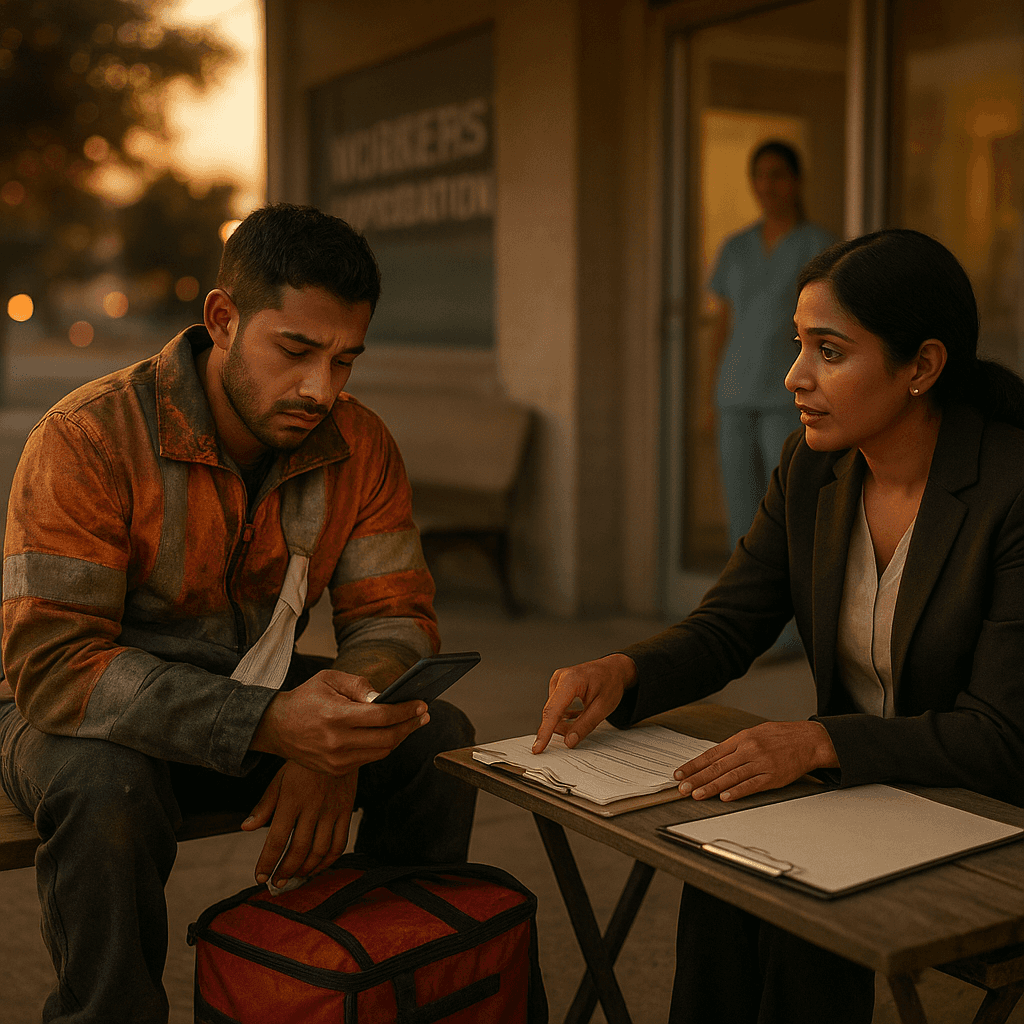
DoorDash accident workers comp explained: Learn when app occupational accident policies apply, how to report if a delivery driver is hurt on job, steps to maximize claims, Prop 22 delivery worker benefits in California, and how Uber Eats injury compensation and third-party claims interact, timelines, evidence checklist, insurer contacts, appeals and when to hire attorney.
Estimated reading time: 14 minutes
Updated November 2025
Key Takeaways
Most app-based couriers are treated as independent contractors, so traditional state workers’ compensation usually does not apply; instead, claims often run through an occupational accident policy provided by the app or, in California, Prop 22 benefits.
DoorDash’s occupational accident insurance generally applies only during an “active delivery” window and can include medical coverage up to policy limits and limited disability payments; it typically excludes vehicle or property damage.
Uber Eats injury compensation follows a similar occupational accident model; specifics, reporting steps, and insurer contacts may differ by app and policy.
In California, Prop 22 delivery worker benefits require certain protections for app drivers but do not equal full workers’ comp unless a worker is legally reclassified as an employee.
Documenting your trip/order IDs, timestamps, app status, witness details, and medical records is crucial to avoid denials and support appeals.
You may pursue both the app’s accident benefits and a separate third-party claim against an at-fault driver or property owner when applicable.
Table of Contents
Introduction
Quick answer: Do DoorDash drivers get workers’ comp?
How worker classification matters (employee vs. independent contractor)
DoorDash accident workers comp explained
When coverage applies (active delivery window)
What DoorDash occupational accident insurance covers
What the policy does not cover
What to do if you’re injured on DoorDash
If I was hurt while not on an active delivery — am I covered?
Uber Eats injury compensation: what to expect
Policy similarities and differences
Steps for Uber Eats drivers
DoorDash vs. Uber Eats vs. state workers’ comp: at a glance
Food courier injury rights in California
What Prop 22 delivery worker benefits cover (and what they don’t)
Step-by-step checklist if a delivery driver is hurt on job
Evidence to maximize your DoorDash or Uber claim
Third-party claims and when to pursue them
Common claim outcomes, denials, and appeals
When to consult an attorney
Sample scripts and templates
DoorDash in-app reporting script
Uber Eats in-app reporting script
Insurer phone/email script
Resources
Conclusion
FAQ
Am I eligible for workers’ comp if I’m an independent contractor?
Does Prop 22 mean I can’t get workers’ comp in California?
How long until benefits start?
What if another driver caused my crash?
Introduction
DoorDash accident workers comp is a critical topic for every app-based delivery driver, because app deliveries carry real risk of injury on the road. This article explains whether a delivery driver hurt on job can get compensation, the differences between workers’ comp and occupational accident benefits, and what to do next. You’ll get a quick answer, step‑by‑step claim checklist, an explanation of Prop 22 delivery worker benefits in California, and sample scripts for reporting injuries.
We also point to the specific protections and limits in the app policies and how to navigate them, including the Miley Legal summary of DoorDash insurance coverage and the official DoorDash Occupational Accident FAQ.
Quick answer: Do DoorDash drivers get workers’ comp?
Most DoorDash delivery drivers do not qualify for traditional state workers’ compensation because they are classified as independent contractors; instead they typically rely on the app’s occupational accident insurance or Prop 22 benefits in CA, as noted by Miley Legal and summarized by firms like Rubenstein & Rynecki, Lugar Law, and Pond Lehocky.
If you are legally classified as an employee (rare), you could pursue state workers’ comp. Some firms describe how classification disputes may open the door to employee benefits; see Probinsky Law.
If you are a delivery driver hurt on job, get medical care, document everything, and report the incident in-app immediately, then follow the policy’s claim steps described in the DoorDash Occupational Accident FAQ.
For broader background on traditional workers’ comp eligibility and claims, you can review our guides on who qualifies for workers’ compensation and how to file a workers’ comp claim.
How worker classification matters (employee vs. independent contractor)
An “employee” is a person who performs work under the control and direction of an employer and is typically covered by state workers’ compensation for job-related injuries. An “independent contractor” is a self‑employed worker who controls when/how work is done and, generally, is not entitled to state workers’ compensation.
The legal consequence is big: state workers’ compensation programs cover employees for nearly all work-related injuries, providing medical care and wage replacement; independent contractors generally cannot access state workers’ comp. Practical employee indicators may include having a set schedule, tools or equipment provided by the company, required onboarding and training, and restrictive app control. These indicators vary by state law and can be fact-intensive.
In California, Prop 22 delivery worker benefits changed the landscape. Prop 22 leaves app drivers classified as independent contractors but mandates certain benefits (occupational accident insurance, minimum earnings guarantees, and health stipends). These are not full workers’ comp, as explained in Pond Lehocky’s analysis of Prop 22 and gig worker benefits. For a deeper overview of gig-driver injury compensation in California, see our guide on gig worker injury compensation.
Classification can be contested — if a court or agency determines you were effectively an employee, state workers’ comp could apply. This is rare and very fact‑specific. Discussions of contesting classification and how courts may look at control and economic realities can be found in resources like Lugar Law’s overview, Rubenstein & Rynecki’s DoorDash accident page, and Probinsky Law’s gig worker insights.
If you believe you were misclassified, contact a workers’ comp or employment-law attorney. California workers can also review guidance and rights through the California Department of Industrial Relations.
DoorDash accident workers comp explained
DoorDash accident workers comp is not traditional state workers’ comp for most Dashers. Instead, DoorDash provides an occupational accident insurance policy that applies only in limited circumstances and with specific benefits and exclusions.
When coverage applies (active delivery window)
Coverage typically applies during the “active delivery” window — from the moment you accept a delivery until the order is completed or canceled. It generally does not apply when you are simply logged in and waiting for offers. This “active delivery” concept is described in overviews like the Miley Legal DoorDash insurance summary and the DoorDash Occupational Accident FAQ.
What DoorDash occupational accident insurance covers
According to reported policy details, DoorDash’s occupational accident insurance may cover medical expenses up to $1,000,000 and provide disability payments (for example, up to $500 per week, capped at a percentage of wages such as 50%). Insurer specifics and exact amounts are governed by the policy and can change, so you should verify the current numbers in the DoorDash Occupational Accident FAQ and cross-check summaries like Miley Legal’s coverage write-up.
For general context on what wage-replacement and medical benefits look like in traditional comp (if you’re ever treated as an employee in a misclassification finding), see our guide to what workers’ comp benefits typically cover.
What the policy does not cover
These app-based occupational accident policies are not the same as full workers’ comp. Common exclusions include vehicle or property damage and certain categories of long-term or permanent impairment beyond policy caps. Injuries that happen outside the active-delivery window are also typically excluded. See the Miley Legal policy overview and the official DoorDash FAQ for details.
What to do if you’re injured on DoorDash
Get medical care immediately. If life‑threatening, call 911.
Report in-app as soon as practicable: in your DoorDash app go to Help → “Report an incident.” The process and contact links are in the DoorDash Occupational Accident FAQ.
Document everything: photos of the scene and your injuries, your order/trip ID, screenshots showing acceptance and delivery timestamps, witness names/contact info, and a police report if applicable.
File the claim with the insurer. If the app lists an insurer (some sources mention Blue Star Claims), follow the listed instructions. If you cannot locate the insurer contact, rely on the app Help center and the Occupational Accident FAQ, and consider cross-referencing Miley Legal’s discussion of DoorDash’s insurance.
Consider legal help if your claim is denied or the benefits are insufficient for your losses. For appeals tips in traditional comp contexts, see our guide on how to appeal a workers’ comp denial.
If I was hurt while not on an active delivery — am I covered?
Usually no. Coverage is generally limited to the “active delivery” window. Check the actual policy language and consider your auto or personal insurance, and possible third-party claims where another person or business contributed to the injury. For legal context on DoorDash incidents and potential claims, see Rubenstein & Rynecki’s DoorDash accident overview.
Uber Eats injury compensation: what to expect
Uber Eats injury compensation often mirrors DoorDash’s approach: an occupational accident policy applies during active deliveries, offering medical expense coverage, disability payments, and sometimes survivor benefits. Policy limits and procedures can vary, so confirm details in the app’s help center and insurer documents. See Probinsky Law’s comparison of Uber and DoorDash injury issues and broader classification context from Pond Lehocky.
Policy similarities and differences
Similarities: Both apps rely on occupational accident coverage that generally applies only while actively delivering. Benefits include medical expense coverage and limited disability benefits. See Probinsky Law’s overview.
Differences: Policy limits, exclusions, and insurer contact information can differ. The in-app reporting flow for Uber is not identical to DoorDash. Always follow the prompts under Help in your Uber app and verify any insurer phone numbers listed there.
Steps for Uber Eats drivers
Get medical care urgently; call 911 for serious injuries.
Report within the Uber app (Help → Trips → Report Incident).
Save screenshots of order/trip ID, acceptance and completion times, and your app status.
Follow the insurer’s instructions for a claim and keep copies of everything you submit.
Always save your trip ID, the exact time you accepted and completed the delivery, and screenshots showing you were on a delivery at the time of injury.
DoorDash vs. Uber Eats vs. state workers’ comp: at a glance
Program | When coverage applies | Medical coverage | Disability coverage | Vehicle/property coverage | How to report |
|---|---|---|---|---|---|
DoorDash occupational accident | Active delivery only (accept → complete/cancel) | Up to policy limit (reported up to $1,000,000) | Limited weekly benefits (example amounts vary by policy) | Usually excluded | In-app Help → incident; see DoorDash Occupational Accident FAQ and Miley Legal summary |
Uber Eats occupational accident | Active delivery only | Policy-based limits | Limited weekly benefits | Usually excluded | In-app Help → Trips → Report Incident; see Probinsky Law comparison |
State workers’ comp (employee status) | Work-related injuries/illnesses while employed | Broad medical care per state law | Wage replacement (state formulas) | Not for vehicle repair; separate claims for property damage | Report to employer; file with state system. See our step-by-step claim guide |
Food courier injury rights in California
Prop 22 is a California ballot measure that treats app drivers as independent contractors but requires apps to provide certain minimum benefits. In practice, that means most app-based couriers receive occupational accident coverage and related protections through their platform rather than full state workers’ comp — unless a court or agency finds the worker was misclassified as a contractor and is actually an employee.
Prop 22 delivery worker benefits include mandated occupational accident insurance and other minimums, but they do not equal the full array of workers’ compensation benefits (for example, some permanent disability benefits or wage formulas available to employees). See Pond Lehocky’s summary of Prop 22’s structure. For a traditional California comp overview, consult our California workers’ comp laws guide.
Legal status note: Prop 22 has been litigated and could be affected by future court rulings or legislation. Check for the latest decisions and updates through trusted sources like the California Department of Industrial Relations.
What Prop 22 delivery worker benefits cover (and what they don’t)
Covers: occupational accident insurance (medical and disability for qualifying incidents), minimum earnings guarantees while active, health-care stipends for drivers who meet earnings thresholds, and some limited survivor benefits. See Pond Lehocky’s Prop 22 analysis.
Does not cover/Limitations:
Not full workers’ comp — may exclude certain long-term or permanent impairment benefits compared to state systems.
Typically does not cover vehicle or property damage.
Coverage depends on policy limits, exclusions, and definitions of “active” work.
Caution: Always read the app’s actual occupational accident policy and the insurer’s current contact info. Policies and maximums can change — verify the figures directly in the app help center and official insurer materials before relying on specific dollar amounts.
Step-by-step checklist if a delivery driver is hurt on job
Use the following checklist to protect your claim. These steps apply whether you are seeking DoorDash accident workers comp benefits through an occupational accident policy or pursuing Uber Eats injury compensation under a similar model in a workers comp gig delivery app context.
Immediate safety & medical:
Ensure safety and remove yourself from harm if possible.
Call 911 if life‑threatening; otherwise seek urgent care or the emergency room.
On-scene documentation:
Take photos of the scene, vehicle damage, intersection signs, skid marks, and injuries (date/time stamped).
Collect witness names and phone numbers.
If police attend, get the police report number and officer’s name.
App evidence:
Screenshot order/trip details: order ID, acceptance time, “on my way”/pickup/delivery timestamps, and map route.
Screenshot your app status showing you were “on a delivery” (if possible).
Paper/digital evidence:
Save medical intake forms, bills, receipts, and pay stubs from the days surrounding the injury.
Export or screenshot engagement logs from the app showing time-on-app and delivered orders around the incident.
Reporting & claims:
Report the incident in-app immediately (DoorDash: Help → Occupational Accident Policy FAQ; Uber: Help → Trips → Report Incident).
Call the app’s occupational accident insurer or use the insurer’s online claim portal if listed in the app. Some summaries reference Blue Star Claims; confirm the current insurer through the app or the Miley Legal overview and the platform’s help resources.
Deadlines & timelines:
Report ASAP — ideally within 24–72 hours. Late reporting increases the likelihood of denial.
Follow insurer instructions for medical documentation; keep copies of everything you submit.
Legal escalation:
If denied, appeal through the insurer first and then consult an attorney regarding misclassification or third‑party claims. For appeal basics in employee claims, see our comp denial appeal guide.
For more on general filing steps and avoiding mistakes in employee-based systems, review our comprehensive filing guide.
Evidence to maximize your DoorDash or Uber claim
Medical records: ER/urgent care notes, follow-up visits, PT notes, and prescriptions — these are primary evidence of injury and treatment necessity.
Photos & videos: Injury photos, scene photos, dashcam footage, and phone videos with timestamps.
App evidence: trip/order IDs, acceptance/arrival/completion timestamps, screenshots of app status, and route maps.
Pay & earnings records: direct deposit records and app payout summaries to support wage loss or disability calculations.
Police report: crucial if a motorist or third party caused the crash; supports liability and third‑party recovery.
Witness statements: short written statements with names, contact info, date, and time.
Device forensics: preserve your phone data; do not factory reset. Export logs/screenshots. Quick export tip: on iPhone, use the Photos app to select and AirDrop/email screenshots; on Android, use the Share function to email or back up to cloud immediately.
Take multiple screenshots immediately and email them to yourself with the date/time in the subject line. If the app deletes engagement logs after a period, export them now or submit a written records request to support. For why thorough documentation matters, compare the policy and benefits discussions in the Miley Legal DoorDash insurance overview and Pond Lehocky’s Prop 22 review.
If your case involves traditional employee comp, you can also explore our resources on documenting a work injury and who qualifies for workers’ compensation.
Third-party claims and when to pursue them
Occupational accident benefits are a first line for medical and limited wage payments from the app’s insurer. A third‑party claim is a separate civil claim against someone else who caused your injury — for example, a negligent driver who hit you, or a restaurant or property owner that created a hazard.
You can do both. Many drivers use the app’s policy for immediate care and also pursue the at‑fault party for pain and suffering, vehicle damage, and future losses beyond policy limits. Some policies include subrogation rights, allowing the insurer to seek reimbursement from the at‑fault party, which can affect how settlements are structured. See practical pointers in Rubenstein & Rynecki’s DoorDash accident guidance, New York examples from NYLaw’s delivery driver injury overview, and state comparisons outlined by Lugar Law. For coordinating comp and third-party issues in employee contexts, see our guide on suing a third party while on workers’ comp.
Common claim outcomes, denials, and appeals
Insurers may approve medical bills within policy limits, pay short-term disability, or deny claims for various reasons. Here are frequent denial reasons and how to fix them:
Outside active-delivery window: Provide screenshots of your app status, order ID, GPS route, and acceptance/completion timestamps linking the injury to an active delivery.
Late reporting: Explain the reason (e.g., hospitalization), and submit medical records showing the treatment date/time to corroborate the delay.
Insufficient causation evidence: Add witness statements, the police report, and trip records showing the timing and mechanism of injury.
Start by following the insurer’s internal appeal steps and submit a written appeal with added documents within the deadline listed in the policy. If you are classified as an employee and denied state comp, you can escalate to your state’s workers’ compensation board. If you are an independent contractor and denied an occupational accident or Prop 22 benefit, consult a civil attorney about contract and negligence options. For DoorDash policy details and reporting procedures, reference the Occupational Accident FAQ, and for general coverage points see Miley Legal’s write-up. For classic employee-appeal workflows, review our appeals guide.
Timelines vary by insurer and state law. Best practice: report immediately (0–3 days advisable), file within 30–90 days if a formal claim is required, and appeal within the insurer’s stated appeal period. For comprehensive timelines in employee systems, see our resource on the workers’ comp time limit to file.
When to consult an attorney
Consider hiring a lawyer when any of the following apply:
Benefits are denied or unreasonably delayed.
Catastrophic or permanent injuries with complex medical needs.
Complicated third‑party liability or multiple at‑fault parties.
Misclassification claims where you believe you functioned as an employee.
Subrogation disputes where an insurer seeks to recoup benefits.
Look for attorneys who handle gig-driver accidents, workers’ compensation, and third‑party personal injury. Ask about contingency fees and experience with Prop 22 and food courier injury rights California issues. See background and context in Rubenstein & Rynecki’s DoorDash accident overview, state comparisons in Lugar Law’s gig-driver page, and the Prop 22 framework summarized by Pond Lehocky. For general questions about whether to retain counsel in employee claims, see our guide to deciding if you need a workers’ comp lawyer.
Sample scripts and templates
Adapt the placeholders (order number, location, date/time) before sending. Keep a copy of everything you submit. These scripts reflect the language many insurers and platforms expect in occupational accident claims for gig drivers.
DoorDash in-app reporting script
“I was injured while delivering order #[Order Number] at [location] on [date/time]. I was actively on a delivery and need to file a claim under DoorDash’s occupational accident policy. Please advise the claim contact and next steps.”
Keywords to include near the top if space allows: DoorDash accident workers comp, delivery driver hurt on job.
Uber Eats in-app reporting script
“I was hurt during an active Uber Eats delivery, order #[Order Number], at [location] on [date/time]. I need to start an Uber Eats injury compensation claim. Please provide insurer contact info and claim form.”
Insurer phone/email script
“Hello — my name is [Name]. I am a delivery driver with [App]. I was injured while on an active delivery on [date/time]. I need to file a claim for medical and disability benefits under the occupational accident policy. My trip/order number is [#].”
Resources
Miley Legal — Insurance coverage overview for DoorDash drivers
NYLaw — Delivery drivers & workers’ compensation (NYC example)
California Department of Industrial Relations (state workers’ comp office)
For broader comp fundamentals and filing help in employee cases, explore our internal guides: who qualifies for workers’ comp, how to file a workers’ comp claim, appealing a comp denial, suing a third party while on comp, and gig worker injury compensation (California).
Conclusion
DoorDash accident workers comp is a shorthand many drivers use, but most app-based couriers must navigate occupational accident policies rather than full state workers’ compensation. The most important steps are the simplest: get medical care, prove you were “on an active delivery,” report in the app, and preserve every document, screenshot, and receipt. In California, Prop 22 delivery worker benefits provide a safety net with meaningful limits; if a negligent third party caused your injuries, consider a separate civil claim. If questions arise about misclassification, benefit denials, or subrogation, speaking with an attorney familiar with food courier injury rights California can help you protect your recovery.
If you were injured while delivering, gather evidence, report the incident in your app now, and seek medical attention.
Need help now? Get a free and instant case evaluation by US Work Accident Lawyers. See if your case qualifies within 30-seconds at https://usworkaccidentlawyer.com.
FAQ
Am I eligible for workers’ comp if I’m an independent contractor?
Most independent contractors working for apps like DoorDash or Uber Eats are not eligible for traditional state workers’ comp; they typically rely on occupational accident policies provided by the app. See the discussion in Rubenstein & Rynecki’s DoorDash accident overview. This distinction affects DoorDash accident workers comp and the broader workers comp gig delivery app landscape.
Does Prop 22 mean I can’t get workers’ comp in California?
Generally, Prop 22 provides separate occupational accident and related benefits for app drivers; it does not provide full state workers’ comp unless a court finds you were actually an employee. For details, see Pond Lehocky’s analysis on Prop 22 delivery worker benefits and food courier injury rights California.
How long until benefits start?
Timing varies by insurer and claim. Some medical expenses may be covered quickly after approval, but disability payments can take days to weeks depending on documentation and insurer processes. See the coverage overview at Miley Legal for DoorDash accident workers comp context and Uber Eats injury compensation parallels.
What if another driver caused my crash?
You can use the app’s occupational accident policy for immediate medical care and still pursue a third‑party liability claim against the at‑fault driver for additional damages. Consult an attorney if damages exceed insurer payments. This path is common for a delivery driver hurt on job in a workers comp gig delivery app environment.
This article is for informational purposes only and does not constitute legal advice. Consult a qualified attorney for advice about your situation.
Estimated reading time: 14 minutes
Updated November 2025
Key Takeaways
Most app-based couriers are treated as independent contractors, so traditional state workers’ compensation usually does not apply; instead, claims often run through an occupational accident policy provided by the app or, in California, Prop 22 benefits.
DoorDash’s occupational accident insurance generally applies only during an “active delivery” window and can include medical coverage up to policy limits and limited disability payments; it typically excludes vehicle or property damage.
Uber Eats injury compensation follows a similar occupational accident model; specifics, reporting steps, and insurer contacts may differ by app and policy.
In California, Prop 22 delivery worker benefits require certain protections for app drivers but do not equal full workers’ comp unless a worker is legally reclassified as an employee.
Documenting your trip/order IDs, timestamps, app status, witness details, and medical records is crucial to avoid denials and support appeals.
You may pursue both the app’s accident benefits and a separate third-party claim against an at-fault driver or property owner when applicable.
Table of Contents
Introduction
Quick answer: Do DoorDash drivers get workers’ comp?
How worker classification matters (employee vs. independent contractor)
DoorDash accident workers comp explained
When coverage applies (active delivery window)
What DoorDash occupational accident insurance covers
What the policy does not cover
What to do if you’re injured on DoorDash
If I was hurt while not on an active delivery — am I covered?
Uber Eats injury compensation: what to expect
Policy similarities and differences
Steps for Uber Eats drivers
DoorDash vs. Uber Eats vs. state workers’ comp: at a glance
Food courier injury rights in California
What Prop 22 delivery worker benefits cover (and what they don’t)
Step-by-step checklist if a delivery driver is hurt on job
Evidence to maximize your DoorDash or Uber claim
Third-party claims and when to pursue them
Common claim outcomes, denials, and appeals
When to consult an attorney
Sample scripts and templates
DoorDash in-app reporting script
Uber Eats in-app reporting script
Insurer phone/email script
Resources
Conclusion
FAQ
Am I eligible for workers’ comp if I’m an independent contractor?
Does Prop 22 mean I can’t get workers’ comp in California?
How long until benefits start?
What if another driver caused my crash?
Introduction
DoorDash accident workers comp is a critical topic for every app-based delivery driver, because app deliveries carry real risk of injury on the road. This article explains whether a delivery driver hurt on job can get compensation, the differences between workers’ comp and occupational accident benefits, and what to do next. You’ll get a quick answer, step‑by‑step claim checklist, an explanation of Prop 22 delivery worker benefits in California, and sample scripts for reporting injuries.
We also point to the specific protections and limits in the app policies and how to navigate them, including the Miley Legal summary of DoorDash insurance coverage and the official DoorDash Occupational Accident FAQ.
Quick answer: Do DoorDash drivers get workers’ comp?
Most DoorDash delivery drivers do not qualify for traditional state workers’ compensation because they are classified as independent contractors; instead they typically rely on the app’s occupational accident insurance or Prop 22 benefits in CA, as noted by Miley Legal and summarized by firms like Rubenstein & Rynecki, Lugar Law, and Pond Lehocky.
If you are legally classified as an employee (rare), you could pursue state workers’ comp. Some firms describe how classification disputes may open the door to employee benefits; see Probinsky Law.
If you are a delivery driver hurt on job, get medical care, document everything, and report the incident in-app immediately, then follow the policy’s claim steps described in the DoorDash Occupational Accident FAQ.
For broader background on traditional workers’ comp eligibility and claims, you can review our guides on who qualifies for workers’ compensation and how to file a workers’ comp claim.
How worker classification matters (employee vs. independent contractor)
An “employee” is a person who performs work under the control and direction of an employer and is typically covered by state workers’ compensation for job-related injuries. An “independent contractor” is a self‑employed worker who controls when/how work is done and, generally, is not entitled to state workers’ compensation.
The legal consequence is big: state workers’ compensation programs cover employees for nearly all work-related injuries, providing medical care and wage replacement; independent contractors generally cannot access state workers’ comp. Practical employee indicators may include having a set schedule, tools or equipment provided by the company, required onboarding and training, and restrictive app control. These indicators vary by state law and can be fact-intensive.
In California, Prop 22 delivery worker benefits changed the landscape. Prop 22 leaves app drivers classified as independent contractors but mandates certain benefits (occupational accident insurance, minimum earnings guarantees, and health stipends). These are not full workers’ comp, as explained in Pond Lehocky’s analysis of Prop 22 and gig worker benefits. For a deeper overview of gig-driver injury compensation in California, see our guide on gig worker injury compensation.
Classification can be contested — if a court or agency determines you were effectively an employee, state workers’ comp could apply. This is rare and very fact‑specific. Discussions of contesting classification and how courts may look at control and economic realities can be found in resources like Lugar Law’s overview, Rubenstein & Rynecki’s DoorDash accident page, and Probinsky Law’s gig worker insights.
If you believe you were misclassified, contact a workers’ comp or employment-law attorney. California workers can also review guidance and rights through the California Department of Industrial Relations.
DoorDash accident workers comp explained
DoorDash accident workers comp is not traditional state workers’ comp for most Dashers. Instead, DoorDash provides an occupational accident insurance policy that applies only in limited circumstances and with specific benefits and exclusions.
When coverage applies (active delivery window)
Coverage typically applies during the “active delivery” window — from the moment you accept a delivery until the order is completed or canceled. It generally does not apply when you are simply logged in and waiting for offers. This “active delivery” concept is described in overviews like the Miley Legal DoorDash insurance summary and the DoorDash Occupational Accident FAQ.
What DoorDash occupational accident insurance covers
According to reported policy details, DoorDash’s occupational accident insurance may cover medical expenses up to $1,000,000 and provide disability payments (for example, up to $500 per week, capped at a percentage of wages such as 50%). Insurer specifics and exact amounts are governed by the policy and can change, so you should verify the current numbers in the DoorDash Occupational Accident FAQ and cross-check summaries like Miley Legal’s coverage write-up.
For general context on what wage-replacement and medical benefits look like in traditional comp (if you’re ever treated as an employee in a misclassification finding), see our guide to what workers’ comp benefits typically cover.
What the policy does not cover
These app-based occupational accident policies are not the same as full workers’ comp. Common exclusions include vehicle or property damage and certain categories of long-term or permanent impairment beyond policy caps. Injuries that happen outside the active-delivery window are also typically excluded. See the Miley Legal policy overview and the official DoorDash FAQ for details.
What to do if you’re injured on DoorDash
Get medical care immediately. If life‑threatening, call 911.
Report in-app as soon as practicable: in your DoorDash app go to Help → “Report an incident.” The process and contact links are in the DoorDash Occupational Accident FAQ.
Document everything: photos of the scene and your injuries, your order/trip ID, screenshots showing acceptance and delivery timestamps, witness names/contact info, and a police report if applicable.
File the claim with the insurer. If the app lists an insurer (some sources mention Blue Star Claims), follow the listed instructions. If you cannot locate the insurer contact, rely on the app Help center and the Occupational Accident FAQ, and consider cross-referencing Miley Legal’s discussion of DoorDash’s insurance.
Consider legal help if your claim is denied or the benefits are insufficient for your losses. For appeals tips in traditional comp contexts, see our guide on how to appeal a workers’ comp denial.
If I was hurt while not on an active delivery — am I covered?
Usually no. Coverage is generally limited to the “active delivery” window. Check the actual policy language and consider your auto or personal insurance, and possible third-party claims where another person or business contributed to the injury. For legal context on DoorDash incidents and potential claims, see Rubenstein & Rynecki’s DoorDash accident overview.
Uber Eats injury compensation: what to expect
Uber Eats injury compensation often mirrors DoorDash’s approach: an occupational accident policy applies during active deliveries, offering medical expense coverage, disability payments, and sometimes survivor benefits. Policy limits and procedures can vary, so confirm details in the app’s help center and insurer documents. See Probinsky Law’s comparison of Uber and DoorDash injury issues and broader classification context from Pond Lehocky.
Policy similarities and differences
Similarities: Both apps rely on occupational accident coverage that generally applies only while actively delivering. Benefits include medical expense coverage and limited disability benefits. See Probinsky Law’s overview.
Differences: Policy limits, exclusions, and insurer contact information can differ. The in-app reporting flow for Uber is not identical to DoorDash. Always follow the prompts under Help in your Uber app and verify any insurer phone numbers listed there.
Steps for Uber Eats drivers
Get medical care urgently; call 911 for serious injuries.
Report within the Uber app (Help → Trips → Report Incident).
Save screenshots of order/trip ID, acceptance and completion times, and your app status.
Follow the insurer’s instructions for a claim and keep copies of everything you submit.
Always save your trip ID, the exact time you accepted and completed the delivery, and screenshots showing you were on a delivery at the time of injury.
DoorDash vs. Uber Eats vs. state workers’ comp: at a glance
Program | When coverage applies | Medical coverage | Disability coverage | Vehicle/property coverage | How to report |
|---|---|---|---|---|---|
DoorDash occupational accident | Active delivery only (accept → complete/cancel) | Up to policy limit (reported up to $1,000,000) | Limited weekly benefits (example amounts vary by policy) | Usually excluded | In-app Help → incident; see DoorDash Occupational Accident FAQ and Miley Legal summary |
Uber Eats occupational accident | Active delivery only | Policy-based limits | Limited weekly benefits | Usually excluded | In-app Help → Trips → Report Incident; see Probinsky Law comparison |
State workers’ comp (employee status) | Work-related injuries/illnesses while employed | Broad medical care per state law | Wage replacement (state formulas) | Not for vehicle repair; separate claims for property damage | Report to employer; file with state system. See our step-by-step claim guide |
Food courier injury rights in California
Prop 22 is a California ballot measure that treats app drivers as independent contractors but requires apps to provide certain minimum benefits. In practice, that means most app-based couriers receive occupational accident coverage and related protections through their platform rather than full state workers’ comp — unless a court or agency finds the worker was misclassified as a contractor and is actually an employee.
Prop 22 delivery worker benefits include mandated occupational accident insurance and other minimums, but they do not equal the full array of workers’ compensation benefits (for example, some permanent disability benefits or wage formulas available to employees). See Pond Lehocky’s summary of Prop 22’s structure. For a traditional California comp overview, consult our California workers’ comp laws guide.
Legal status note: Prop 22 has been litigated and could be affected by future court rulings or legislation. Check for the latest decisions and updates through trusted sources like the California Department of Industrial Relations.
What Prop 22 delivery worker benefits cover (and what they don’t)
Covers: occupational accident insurance (medical and disability for qualifying incidents), minimum earnings guarantees while active, health-care stipends for drivers who meet earnings thresholds, and some limited survivor benefits. See Pond Lehocky’s Prop 22 analysis.
Does not cover/Limitations:
Not full workers’ comp — may exclude certain long-term or permanent impairment benefits compared to state systems.
Typically does not cover vehicle or property damage.
Coverage depends on policy limits, exclusions, and definitions of “active” work.
Caution: Always read the app’s actual occupational accident policy and the insurer’s current contact info. Policies and maximums can change — verify the figures directly in the app help center and official insurer materials before relying on specific dollar amounts.
Step-by-step checklist if a delivery driver is hurt on job
Use the following checklist to protect your claim. These steps apply whether you are seeking DoorDash accident workers comp benefits through an occupational accident policy or pursuing Uber Eats injury compensation under a similar model in a workers comp gig delivery app context.
Immediate safety & medical:
Ensure safety and remove yourself from harm if possible.
Call 911 if life‑threatening; otherwise seek urgent care or the emergency room.
On-scene documentation:
Take photos of the scene, vehicle damage, intersection signs, skid marks, and injuries (date/time stamped).
Collect witness names and phone numbers.
If police attend, get the police report number and officer’s name.
App evidence:
Screenshot order/trip details: order ID, acceptance time, “on my way”/pickup/delivery timestamps, and map route.
Screenshot your app status showing you were “on a delivery” (if possible).
Paper/digital evidence:
Save medical intake forms, bills, receipts, and pay stubs from the days surrounding the injury.
Export or screenshot engagement logs from the app showing time-on-app and delivered orders around the incident.
Reporting & claims:
Report the incident in-app immediately (DoorDash: Help → Occupational Accident Policy FAQ; Uber: Help → Trips → Report Incident).
Call the app’s occupational accident insurer or use the insurer’s online claim portal if listed in the app. Some summaries reference Blue Star Claims; confirm the current insurer through the app or the Miley Legal overview and the platform’s help resources.
Deadlines & timelines:
Report ASAP — ideally within 24–72 hours. Late reporting increases the likelihood of denial.
Follow insurer instructions for medical documentation; keep copies of everything you submit.
Legal escalation:
If denied, appeal through the insurer first and then consult an attorney regarding misclassification or third‑party claims. For appeal basics in employee claims, see our comp denial appeal guide.
For more on general filing steps and avoiding mistakes in employee-based systems, review our comprehensive filing guide.
Evidence to maximize your DoorDash or Uber claim
Medical records: ER/urgent care notes, follow-up visits, PT notes, and prescriptions — these are primary evidence of injury and treatment necessity.
Photos & videos: Injury photos, scene photos, dashcam footage, and phone videos with timestamps.
App evidence: trip/order IDs, acceptance/arrival/completion timestamps, screenshots of app status, and route maps.
Pay & earnings records: direct deposit records and app payout summaries to support wage loss or disability calculations.
Police report: crucial if a motorist or third party caused the crash; supports liability and third‑party recovery.
Witness statements: short written statements with names, contact info, date, and time.
Device forensics: preserve your phone data; do not factory reset. Export logs/screenshots. Quick export tip: on iPhone, use the Photos app to select and AirDrop/email screenshots; on Android, use the Share function to email or back up to cloud immediately.
Take multiple screenshots immediately and email them to yourself with the date/time in the subject line. If the app deletes engagement logs after a period, export them now or submit a written records request to support. For why thorough documentation matters, compare the policy and benefits discussions in the Miley Legal DoorDash insurance overview and Pond Lehocky’s Prop 22 review.
If your case involves traditional employee comp, you can also explore our resources on documenting a work injury and who qualifies for workers’ compensation.
Third-party claims and when to pursue them
Occupational accident benefits are a first line for medical and limited wage payments from the app’s insurer. A third‑party claim is a separate civil claim against someone else who caused your injury — for example, a negligent driver who hit you, or a restaurant or property owner that created a hazard.
You can do both. Many drivers use the app’s policy for immediate care and also pursue the at‑fault party for pain and suffering, vehicle damage, and future losses beyond policy limits. Some policies include subrogation rights, allowing the insurer to seek reimbursement from the at‑fault party, which can affect how settlements are structured. See practical pointers in Rubenstein & Rynecki’s DoorDash accident guidance, New York examples from NYLaw’s delivery driver injury overview, and state comparisons outlined by Lugar Law. For coordinating comp and third-party issues in employee contexts, see our guide on suing a third party while on workers’ comp.
Common claim outcomes, denials, and appeals
Insurers may approve medical bills within policy limits, pay short-term disability, or deny claims for various reasons. Here are frequent denial reasons and how to fix them:
Outside active-delivery window: Provide screenshots of your app status, order ID, GPS route, and acceptance/completion timestamps linking the injury to an active delivery.
Late reporting: Explain the reason (e.g., hospitalization), and submit medical records showing the treatment date/time to corroborate the delay.
Insufficient causation evidence: Add witness statements, the police report, and trip records showing the timing and mechanism of injury.
Start by following the insurer’s internal appeal steps and submit a written appeal with added documents within the deadline listed in the policy. If you are classified as an employee and denied state comp, you can escalate to your state’s workers’ compensation board. If you are an independent contractor and denied an occupational accident or Prop 22 benefit, consult a civil attorney about contract and negligence options. For DoorDash policy details and reporting procedures, reference the Occupational Accident FAQ, and for general coverage points see Miley Legal’s write-up. For classic employee-appeal workflows, review our appeals guide.
Timelines vary by insurer and state law. Best practice: report immediately (0–3 days advisable), file within 30–90 days if a formal claim is required, and appeal within the insurer’s stated appeal period. For comprehensive timelines in employee systems, see our resource on the workers’ comp time limit to file.
When to consult an attorney
Consider hiring a lawyer when any of the following apply:
Benefits are denied or unreasonably delayed.
Catastrophic or permanent injuries with complex medical needs.
Complicated third‑party liability or multiple at‑fault parties.
Misclassification claims where you believe you functioned as an employee.
Subrogation disputes where an insurer seeks to recoup benefits.
Look for attorneys who handle gig-driver accidents, workers’ compensation, and third‑party personal injury. Ask about contingency fees and experience with Prop 22 and food courier injury rights California issues. See background and context in Rubenstein & Rynecki’s DoorDash accident overview, state comparisons in Lugar Law’s gig-driver page, and the Prop 22 framework summarized by Pond Lehocky. For general questions about whether to retain counsel in employee claims, see our guide to deciding if you need a workers’ comp lawyer.
Sample scripts and templates
Adapt the placeholders (order number, location, date/time) before sending. Keep a copy of everything you submit. These scripts reflect the language many insurers and platforms expect in occupational accident claims for gig drivers.
DoorDash in-app reporting script
“I was injured while delivering order #[Order Number] at [location] on [date/time]. I was actively on a delivery and need to file a claim under DoorDash’s occupational accident policy. Please advise the claim contact and next steps.”
Keywords to include near the top if space allows: DoorDash accident workers comp, delivery driver hurt on job.
Uber Eats in-app reporting script
“I was hurt during an active Uber Eats delivery, order #[Order Number], at [location] on [date/time]. I need to start an Uber Eats injury compensation claim. Please provide insurer contact info and claim form.”
Insurer phone/email script
“Hello — my name is [Name]. I am a delivery driver with [App]. I was injured while on an active delivery on [date/time]. I need to file a claim for medical and disability benefits under the occupational accident policy. My trip/order number is [#].”
Resources
Miley Legal — Insurance coverage overview for DoorDash drivers
NYLaw — Delivery drivers & workers’ compensation (NYC example)
California Department of Industrial Relations (state workers’ comp office)
For broader comp fundamentals and filing help in employee cases, explore our internal guides: who qualifies for workers’ comp, how to file a workers’ comp claim, appealing a comp denial, suing a third party while on comp, and gig worker injury compensation (California).
Conclusion
DoorDash accident workers comp is a shorthand many drivers use, but most app-based couriers must navigate occupational accident policies rather than full state workers’ compensation. The most important steps are the simplest: get medical care, prove you were “on an active delivery,” report in the app, and preserve every document, screenshot, and receipt. In California, Prop 22 delivery worker benefits provide a safety net with meaningful limits; if a negligent third party caused your injuries, consider a separate civil claim. If questions arise about misclassification, benefit denials, or subrogation, speaking with an attorney familiar with food courier injury rights California can help you protect your recovery.
If you were injured while delivering, gather evidence, report the incident in your app now, and seek medical attention.
Need help now? Get a free and instant case evaluation by US Work Accident Lawyers. See if your case qualifies within 30-seconds at https://usworkaccidentlawyer.com.
FAQ
Am I eligible for workers’ comp if I’m an independent contractor?
Most independent contractors working for apps like DoorDash or Uber Eats are not eligible for traditional state workers’ comp; they typically rely on occupational accident policies provided by the app. See the discussion in Rubenstein & Rynecki’s DoorDash accident overview. This distinction affects DoorDash accident workers comp and the broader workers comp gig delivery app landscape.
Does Prop 22 mean I can’t get workers’ comp in California?
Generally, Prop 22 provides separate occupational accident and related benefits for app drivers; it does not provide full state workers’ comp unless a court finds you were actually an employee. For details, see Pond Lehocky’s analysis on Prop 22 delivery worker benefits and food courier injury rights California.
How long until benefits start?
Timing varies by insurer and claim. Some medical expenses may be covered quickly after approval, but disability payments can take days to weeks depending on documentation and insurer processes. See the coverage overview at Miley Legal for DoorDash accident workers comp context and Uber Eats injury compensation parallels.
What if another driver caused my crash?
You can use the app’s occupational accident policy for immediate medical care and still pursue a third‑party liability claim against the at‑fault driver for additional damages. Consult an attorney if damages exceed insurer payments. This path is common for a delivery driver hurt on job in a workers comp gig delivery app environment.
This article is for informational purposes only and does not constitute legal advice. Consult a qualified attorney for advice about your situation.
Insights
Insights
Insights
More Legal Insights
Dec 3, 2025
Josefina Submitted a Complaint Online That Is Non-Serious in Nature. How Will OSHA Most Likely Respond? What to Expect
Starting and running a small business is exciting—but it also comes with legal responsibilities.
Dec 3, 2025
Josefina Submitted a Complaint Online That Is Non-Serious in Nature. How Will OSHA Most Likely Respond? What to Expect
Starting and running a small business is exciting—but it also comes with legal responsibilities.
Dec 3, 2025
Josefina Submitted a Complaint Online That Is Non-Serious in Nature. How Will OSHA Most Likely Respond? What to Expect
Starting and running a small business is exciting—but it also comes with legal responsibilities.
Dec 3, 2025
Injured Working at Amazon Warehouse? What to Do Next and How to Get Compensation
Starting and running a small business is exciting—but it also comes with legal responsibilities.
Dec 3, 2025
Injured Working at Amazon Warehouse? What to Do Next and How to Get Compensation
Starting and running a small business is exciting—but it also comes with legal responsibilities.
Dec 3, 2025
Injured Working at Amazon Warehouse? What to Do Next and How to Get Compensation
Starting and running a small business is exciting—but it also comes with legal responsibilities.

Dec 2, 2025
You Have the Right to Be Free From ________in the Workplace When Exercising Safety and Health Rights: What Workers Need
Starting and running a small business is exciting—but it also comes with legal responsibilities.
Dec 2, 2025
You Have the Right to Be Free From ________in the Workplace When Exercising Safety and Health Rights: What Workers Need
Starting and running a small business is exciting—but it also comes with legal responsibilities.
Dec 2, 2025
You Have the Right to Be Free From ________in the Workplace When Exercising Safety and Health Rights: What Workers Need
Starting and running a small business is exciting—but it also comes with legal responsibilities.
Dec 2, 2025
Hotel Worker Injury Claim: Your Rights and Steps After a Workplace Injury
Starting and running a small business is exciting—but it also comes with legal responsibilities.
Dec 2, 2025
Hotel Worker Injury Claim: Your Rights and Steps After a Workplace Injury
Starting and running a small business is exciting—but it also comes with legal responsibilities.
Dec 2, 2025
Hotel Worker Injury Claim: Your Rights and Steps After a Workplace Injury
Starting and running a small business is exciting—but it also comes with legal responsibilities.
Think You May Have a Case?
From confusion to clarity — we’re here to guide you, support you, and fight for your rights. Get clear answers, fast action, and real support when you need it most.
Think You May Have a Case?
From confusion to clarity — we’re here to guide you, support you, and fight for your rights. Get clear answers, fast action, and real support when you need it most.
Think You May Have a Case?
From confusion to clarity — we’re here to guide you, support you, and fight for your rights. Get clear answers, fast action, and real support when you need it most.